Explainer
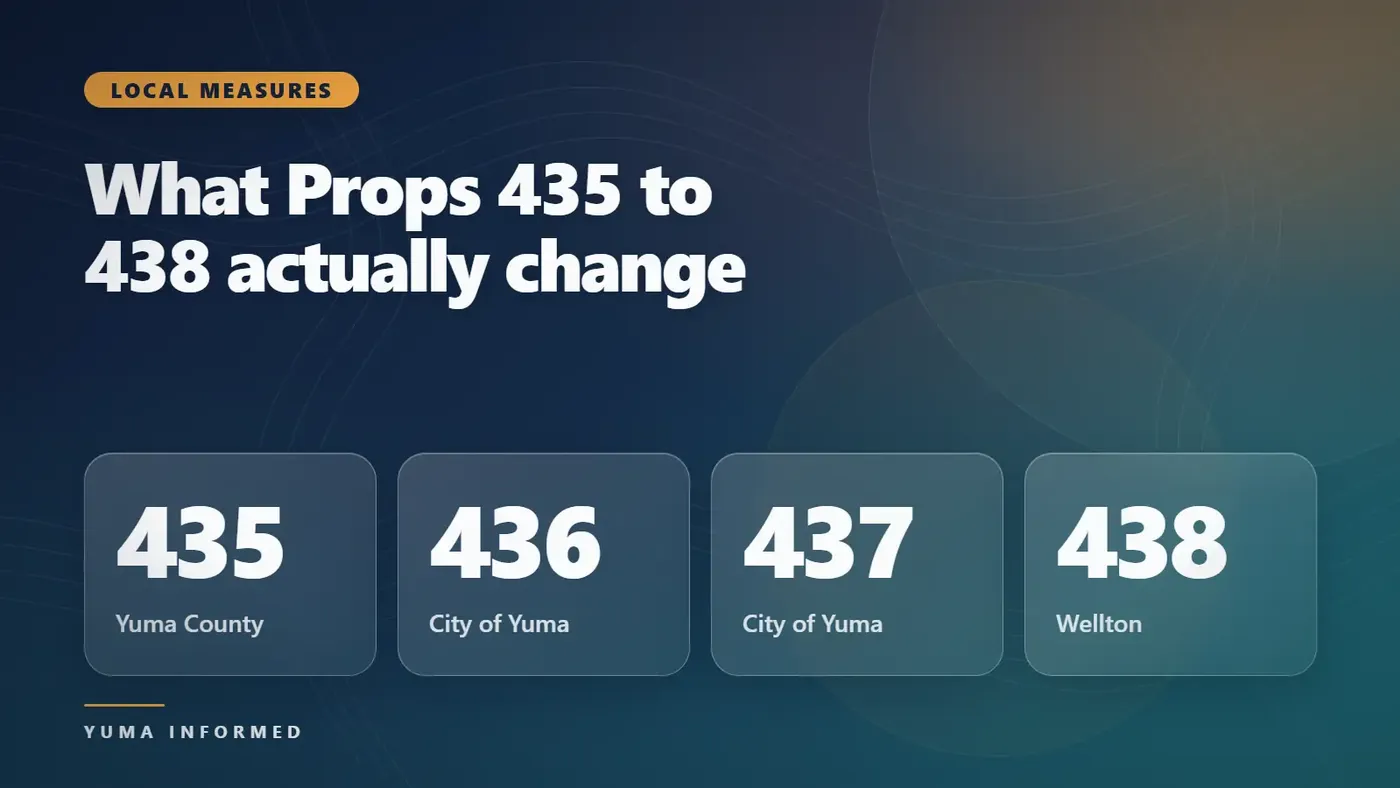
Three spending limits up, one ballot bar down: what Props 435 through 438 actually do
Three of Yuma County's four local measures are about a 1980 spending formula most people have never heard of. None raises a tax. The fourth makes it easier to get on the Yuma city ballot after a year when three winners had to run as write-ins.
Founder & Publisher
- Published
Full article
You probably voted yes on at least one spending limit Tuesday. Most people in Yuma County did.
As of the County's last election-night update, all four local measures were winning comfortably:
- Prop 435 (Yuma County): 63.99 percent yes
- Prop 436 (City of Yuma): 69.71 percent yes
- Prop 437 (City of Yuma): 69.08 percent yes
- Prop 438 (Town of Wellton): 64.51 percent yes
We explained these before the election (435, 436, 437). Now that they're passing, here's the short version of what changes.
Three of them are about the same thing. So let's do that thing once.
The 1980 spending limit, in one breath
In 1980, Arizona voters put a spending cap on every county, city and town into the state constitution. It started with what each one spent in fiscal 1979-80, and it grows each year with population and inflation.
It limits how much local money a government can spend. It doesn't limit how much it collects. So a city can have money in the bank and still not be allowed to spend it.
Voters have three ways to loosen it. They can approve a one-year override. They can approve a four-year "home rule" limit. Or they can permanently raise the starting number, called the base. Props 435, 436 and 438 do that last one.
None of them raises a tax. That's not spin. A spending limit and a tax rate are different things, and these measures only touch the limit.
To be fair to the skeptics: a higher limit does take away a brake. Officials say they'll still adopt balanced budgets in public every year. But the cap was designed to slow spending down, and now it slows it down a little less.
Prop 435: Yuma County, $6.2 million
- Permanently raises the County's base by $6.2 million, starting in fiscal 2027-28.
- For context, the County's total budget this year is $552 million. The state formula caps the part subject to the limit at $121 million. (Grants, bonds and some other money don't count against it.)
- It's the first time the County has asked voters to adjust its base since the limit started.
- The County says it creates no new tax, fee or revenue, and the Board of Supervisors still adopts the budget each year.
Prop 436: City of Yuma, $30 million
- Permanently raises the City's base by $30 million.
- The City's state-set limit this fiscal year is about $175 million. A City chart shows Yuma's limit running lower than many peer cities.
- City officials say it lets them spend money the City already collects on existing and planned services and infrastructure. No new tax, no rate increase.
Prop 438: Wellton, $600,000
- Permanently raises Wellton's base by $600,000.
- There's a backstory. Wellton voters approved a four-year home rule limit in 2022. The town still went over its constitutional limit in fiscal 2023. Normally that costs a town state-shared revenue. Instead, the Legislature passed a law in 2025 setting Wellton's penalty at $100.
Prop 437: the one that isn't about money
This one changes the City of Yuma's charter, and it's about who gets on the ballot.
To run for mayor or Council, you need signatures on a nominating petition. The number has been based on 3 percent of ballots cast in the City's last general election. Prop 437 bases it on the last primary instead. Fewer people vote in primaries, so the number drops.
This year, candidates needed 998 signatures, according to KAWC.
Here's why it came up. Only four candidates qualified by petition this year: Mayor Doug Nicholls and three Council candidates. Three others, one for mayor and two for Council, ran as write-ins. Nicholls told KAWC the change would make it easier for potential candidates to get their names on the ballot.
My opinion: That's a fair goal. A ballot with more names on it is a healthier ballot, and 998 signatures was a real wall for a first-time candidate.
What happens next
Nothing changes until the results are certified. The Board of Supervisors canvasses by Nov. 19. The City and Wellton certify their own measures after that. The County's change doesn't kick in until fiscal 2027-28.
More 2026 election coverage is in the Yuma Informed Election Center.
Where this comes from
- Yuma County, unofficial election results, upload of about 1:31 a.m. Nov. 4. Official, unofficial results.
- Yuma County, Expenditure Limitation page and Prop 435 arguments notice, June 23, 2026. Official.
- City of Yuma, Proposition 436: Permanent Base Adjustment. Official.
- KAWC, "What you should know about 2026 City of Yuma Propositions 436 and 437", Oct. 26, 2026. Reporting. Signature count, write-ins, Nicholls quote.
- Arizona Legislature, Laws 2025, Chapter 162 (SB 1521), signed May 12, 2025. Statute. Wellton's $100 penalty.
- Arizona Senate, fact sheet on SB 1263 strike-everything amendment, Feb. 13, 2025. Official. Wellton's 2022 home rule vote and how expenditure limits work.