Explainer
Proposition 436: How a $30 Million Change Could Raise Yuma’s Spending Limit by $368 Million
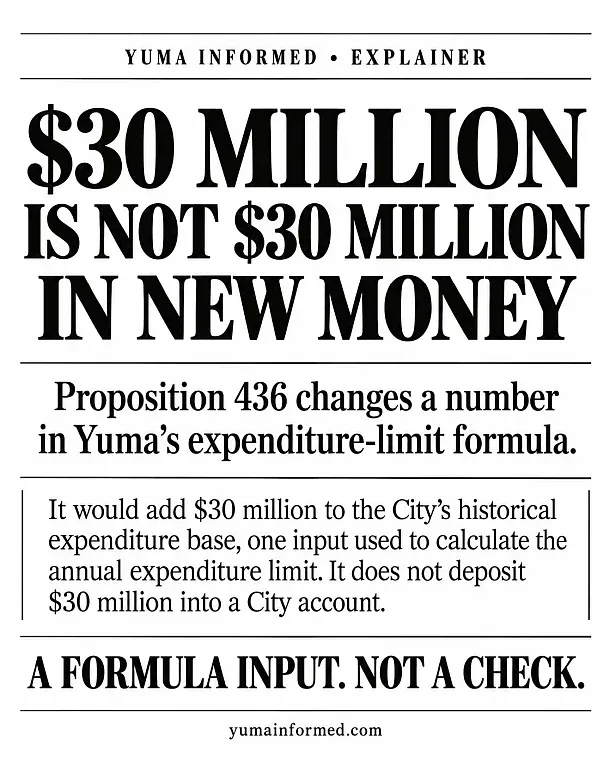
The proposed $30 million changes the base used to calculate spending authority. It does not create $30 million in cash. Here is how the AEL and FY2028 timing fit together.
Founder & Publisher
- Published
Full article
Yuma voters are being asked to change a spending formula dating back to 1980. The proposal would give the City substantially more spending authority, but it wouldn't put another dollar in its bank account.
Yuma voters will see a $30 million figure attached to Proposition 436 on the November 3 ballot. But there's another number worth paying attention to: $368,374,595.
That's how much the City estimates its annual expenditure limitation would increase in fiscal year 2027-28 if voters approve the measure.
Quite a difference between those two numbers. And unless you understand how Arizona calculates municipal spending limits, it's easy to get the wrong impression about what you're voting on.
Proposition 436 would permanently increase the historical spending base used in a state-mandated formula. It would not give Yuma $30 million in new revenue, much less $368 million.
The distinction matters because there's a considerable difference between having money available and having the legal authority to spend it.
A spending limit rooted in 1980
Arizona voters approved the state's expenditure limitation system in 1980. Under Article IX, Section 20 of the Arizona Constitution, cities and towns have annual limits on how much they can spend from certain local revenues.
The starting point is what each municipality actually spent from qualifying local revenues during fiscal year 1979-80.
That historical amount becomes the base for a calculation that adjusts for population changes and the cost of living. The Economic Estimates Commission determines the applicable limits each year.
In other words, Yuma isn't operating under a spending ceiling frozen at 1980 dollar amounts. The formula already accounts for population growth and inflation.
But the City argues those adjustments haven't been enough.
In its report accompanying Ordinance O2026-015, City officials point to changing service demands, seasonal residents, infrastructure needs and modern operating conditions.
Their argument is that Yuma has changed substantially since 1980, while the original expenditure base hasn't adequately kept pace with the City's needs.
That's the City's position. Whether those circumstances justify the particular adjustment being proposed is something voters must decide.
The age of the formula alone doesn't settle that question.
Where the $368 million comes from
Proposition 436 would add $30 million to Yuma's historical expenditure base. That adjusted base would then be used in the constitutional formula to determine future annual spending limits.
Here's where the numbers become interesting.
According to the City's 2026 publicity pamphlet and sample ballot, the estimated expenditure limitation for fiscal year 2027-28 would change as follows:
Estimated amount
Without Proposition 436
$192,331,385
With Proposition 436
$560,705,980
Estimated increase
$368,374,595
Those are the City's estimates, not guaranteed future spending figures.
The proposed $30 million adjustment applies to the historical base. Once the constitutional population and cost-of-living adjustments are applied, the estimated effect on the annual limitation is considerably larger.
That's why describing Proposition 436 as simply allowing another $30 million in annual spending would be misleading.
But there's an equally important point on the other side of that equation.
A $560.7 million spending limit doesn't mean Yuma will have $560.7 million available to spend.
It means the City could have that much authority under this particular legal limitation, subject to the rules governing which expenditures count.
Arizona's Constitution also excludes certain types of revenue from the limitation. Federal grants, for example, are treated differently from covered local revenues. Comparing the City's entire budget against a single expenditure-limit figure without accounting for those distinctions wouldn't tell the full story.
The amount Yuma actually spends would still depend on available resources, applicable legal requirements and decisions made through its annual budget process.
Having money and being allowed to spend it
Think of the expenditure limitation as a legal ceiling rather than a bank balance.
Suppose a city has $12 million available for expenditures covered by the limitation, but its legal ceiling is $10 million.
Even though the resources exist, the city generally cannot authorize spending beyond that ceiling without satisfying an applicable constitutional exception or obtaining the necessary approval.
Now suppose voters approve an adjustment that raises the ceiling to $13 million.
The city still has only $12 million available. Raising the ceiling hasn't created another dollar. It has simply removed a restriction that could have prevented the city from spending some of the money it already had.
That's a hypothetical example, not a description of Yuma's finances.
It's also the central distinction behind Proposition 436.
In its June 23 announcement, the City said the measure would allow it to spend revenues it already collects and lawfully receives on existing and planned services, programs and infrastructure.
The proposal addresses how much qualifying revenue the City may spend under the state limitation. It doesn't establish how much revenue the City will actually collect.
Those are separate questions, and neither answers the other.
Does Proposition 436 raise taxes?
No. The measure itself does not raise taxes.
According to the City's explanation, Proposition 436 would not:
- Create a new tax or increase an existing tax rate.
- Establish a new fee.
- Authorize the collection of additional revenue.
Those statements describe what the ballot measure would do.
They don't prevent a future City Council from separately considering taxes or fees through whatever legal procedures apply. But the possibility of a later decision doesn't mean Proposition 436 secretly contains one.
Likewise, approving a higher spending limit would not automatically authorize a particular construction project, hire additional employees or commit the City to spending a specified amount.
The City says it would continue adopting balanced annual budgets based on available revenues.
Those budget decisions would remain separate from the November vote.
Why the City wants the adjustment
Yuma officials say the existing expenditure base no longer adequately reflects what it costs to serve the community.
The City's explanation identifies infrastructure, seasonal population changes and the growing demands of delivering municipal services.
Those concerns are understandable subjects for a city experiencing changes in population and development. But the constitutional formula already includes adjustments for population and inflation, so the argument isn't quite as simple as saying the City has been stuck with a 1980 budget.
The question is whether the existing formula, even with those adjustments, gives Yuma enough room to use its available resources.
City officials believe it doesn't.
One fact worth keeping in mind is that the City's expenditure-limit compliance and its argument for a higher limit are different matters. The Council report says Yuma has remained compliant with the existing limitation.
Proposition 436 is therefore a proposal to change the City's future spending capacity, not evidence that it has already exceeded its legal authority.
And while the City identifies areas where greater flexibility could help, the ballot measure doesn't specify how much additional money would go toward roads, public safety, utilities or any other particular service.
A higher ceiling creates possibilities. It doesn't guarantee outcomes.
What happens if voters approve it?
A yes vote would approve the permanent $30 million adjustment to Yuma's expenditure base.
According to the Council record, the revised base would begin affecting the City's annual expenditure limitation in Fiscal Year 2028, which runs from July 2027 through June 2028.
That timing is worth clarifying. Voters decide the measure in November 2026, but approval doesn't immediately transfer money or change every spending decision made that year.
Future annual limits would be calculated using the revised base.
The adjustment would be permanent, but that doesn't mean the annual limit would remain at one fixed amount forever. The formula would continue accounting for changes in population and the cost of living.
Nor would the City be required to spend everything the higher ceiling permitted.
A no vote would leave the proposed adjustment unapproved. Yuma would continue using its existing expenditure base and applicable constitutional spending framework.
That doesn't automatically mean services would be cut, taxes raised or projects canceled.
Claims about specific consequences would need evidence from City budgets, financial forecasts or project plans. The ballot language alone doesn't establish them.
What voters are really deciding
Proposition 436 comes down to a question about how much spending authority the City of Yuma should have under Arizona's constitutional limits.
The City's case is that the existing framework restricts its ability to use lawfully available revenues for the needs of a modern, growing community.
The proposal would address that concern by permanently changing the historical base used to calculate its annual expenditure limit.
The City's own estimate shows how substantial that change could be: an increase of approximately $368.4 million in the annual legal ceiling for fiscal year 2027-28.
But that estimate is not a revenue forecast, a promised budget increase or a list of projects waiting for funding.
Voters aren't being asked to give the City $30 million. They're being asked to approve a change that could allow the City to spend considerably more of the resources available to it, subject to the applicable rules.
Whether that additional flexibility is warranted is a policy decision.
Understanding exactly what the proposition changes, and what it leaves untouched, is where an informed vote begins.
For the companion ballot measure concerning candidate nomination signatures, along with the broader election overview and supporting records, see Yuma Informed's Yuma Propositions 436 & 437 topic.
Related claims 3
- VerifiedIf approved, Proposition 436 would permanently add $30 million to Yuma’s expenditure base used to calculate the AEL.
The proposal changes the calculation base, not the amount of cash held by the City.
- VerifiedIf approved, the revised Proposition 436 base would begin affecting Yuma’s expenditure limitation in Fiscal Year 2028.
The election date and implementation fiscal year are different milestones.
- VerifiedThe City states that Proposition 436 itself creates no new tax or fee, increases no existing tax rate, and authorizes no additional revenue.
This describes the measure itself, not every future City fiscal decision.
Sources 5
- Primary source · Government recordArizona Constitution, Article IX, Section 20: Expenditure limitation
Official constitutional framework for local expenditure limitations, historical bases, adjustments, and defined revenues.
- Primary source · Government recordCity of Yuma 2026 Publicity Pamphlet and Sample Ballot: Propositions 436 and 437
Official City of Yuma publicity pamphlet and sample ballot containing the final printed ballot text for Propositions 436 and 437 and the City’s Proposition 436 summary analysis.
- Primary source · Government recordCity of Yuma Elections: July 21, 2026 Primary Results and November 3 General/Special Election
Official City of Yuma election information. The page reports the July 21, 2026 primary results, canvassed August 5, 2026, and provides information about the November 3, 2026 general/special election.
- Primary source · Public statementCity of Yuma: Arguments For and Against Propositions 436 and 437 Sought
June 23, 2026 City notice describes both propositions and the publicity-pamphlet argument process.
- Primary source · Government recordO2026-015: Proposition 436 Permanent Base Adjustment
Council legislative record and staff report describe the proposed $30 million permanent adjustment, AEL framework, and FY2028 implementation.
Timeline events 1
- Yuma City Council adopts O2026-015 for Proposition 436 referral to voters
On June 17, 2026, the Yuma City Council adopted Ordinance O2026-015, authorizing Proposition 436 to be submitted to City voters. This records Council action to place the measure before voters; it is not voter approval of Proposition 436.
Related topics 1
- Yuma Propositions 436 & 437
A plain-English evidence guide to City of Yuma Propositions 436 and 437 on the November 3, 2026 ballot. Proposition 436 concerns a permanent adjustment to the City's expenditure base. Proposition 437 concerns how nomination-petition signature requirements for City elected office are calculated.