News
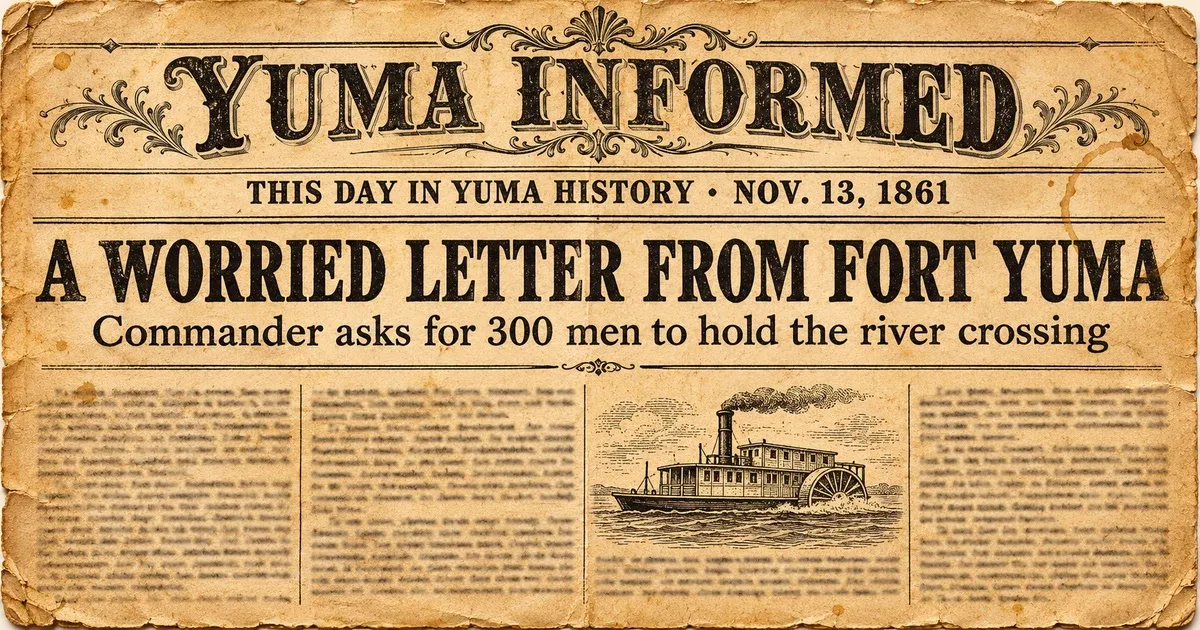
This day in Yuma history: Nov. 13, 1861, and a worried letter from Fort Yuma
On Nov. 13, 1861, eight months into the Civil War, the commander at Fort Yuma sat down at 8 p.m. and wrote to his boss in Los Angeles. He wanted 300 more men. An express rider named Hadji Ali had left that afternoon.
Founder & Publisher
- Published
Full article
At 8 o'clock on the night of Nov. 13, 1861, someone at Fort Yuma was worried.
The Civil War was eight months old. Fort Yuma sat on the California side of the Colorado River, across from what would become Yuma, guarding the crossing that connected California to everything east of it. That night its headquarters sent a dispatch to Col. James H. Carleton, who commanded the Southern District of California from Los Angeles.
The letter survives in the Army's Official Records of the war, and it reads like a man who doesn't want to be the one blamed.
What he asked for
He wanted reinforcements, and he'd done the math. Charter a steamer from San Francisco to the mouth of the Colorado. Bring 300 men and 150 tons of freight upriver, plus two artillery pieces, within 10 days. Total cost, he figured, no more than $20,500.
His case for spending it: Fort Yuma was valuable. He estimated that losing it would cost the United States about $1 million in property, and he called it an important military and moral position.
What's interesting is what he didn't say. He didn't claim an attack was coming. He wrote that he knew of no current plan by the enemy to take the post and wasn't alarmed for his men's safety. He just didn't want to find out the hard way.
A letter on the same page of the record, signed only "West," puts it plainly: somebody would get blamed unless more was done to hold the post, "enemy or no enemy."
The man who carried the mail
One more detail from that night. The dispatch notes that the expressman, Hadji Ali, left at 1:30 that afternoon, and that the overdue steamer finally showed up at the landing within the hour.
That name will ring a bell for anyone who's driven to Quartzsite. Hadji Ali was the camel driver the Army brought from the Middle East in the 1850s for its camel experiment. Soldiers couldn't say his name, so they called him Hi Jolly, and his pyramid-shaped tomb still stands in Quartzsite. After the camel corps fell apart, he stayed in the Southwest and worked as a guide, prospector and mail courier.
Was the Hadji Ali carrying Fort Yuma's express that day the same man? The record doesn't say, and we're not going to say it for it. It was the right place, the right years and the right line of work. You can decide what you think.
Nov. 13 in Yuma weather
For the record, the weather records for this date go back to 1893.
- Hottest Nov. 13: 91 degrees, reached twice, most recently in 2013.
- Coldest: 36 degrees, in 1909.
- Wettest: 1.20 inches of rain, in 1910.
- Typical: an average high around 79 and a low around 55.
Where this comes from
- The War of the Rebellion: Official Records of the Union and Confederate Armies, Series I, Vol. 50, Part I, Fort Yuma dispatch dated Nov. 13, 1861, 8 p.m., as transcribed by civilwar.com. Official record. https://civilwar.com/official-record/950-pacific-part-i/251595-721-series-i-volume-l-i-serial-105-pacific-part-i.html
- AramcoWorld, "Hi Jolly: Uncle Sam's Camel Captain." Reporting; Hadji Ali's name and work. https://www.aramcoworld.com/articles/2021/hi-jolly-uncle-sams-camel-captain
- Sharlot Hall Museum, "The U.S. Army Camel Military Corps in Arizona." History; the nickname and the camel corps. https://archives.sharlothallmuseum.org/articles/days-past-articles/1/the-us-army-camel-military-corps-in-arizona-part-2
- Wikipedia, "Hi Jolly Monument." Reference; the Quartzsite tomb and his later work. https://en.wikipedia.org/wiki/Hi_Jolly_Monument
- Extreme Weather Watch, Yuma Nov. 13 records, compiled from NOAA data, 1893 to 2026. https://www.extremeweatherwatch.com/cities/yuma/day/november-13
Related
Sources 5
- Secondary source / research lead · News reportAramcoWorld, "Hi Jolly: Uncle Sam's Camel Captain."
Reporting; Hadji Ali's name and work.
- Secondary source / research lead · News reportExtreme Weather Watch, Yuma Nov. 13 records
, compiled from NOAA data, 1893 to 2026.
- Primary source · Public statementSharlot Hall Museum, "The U.S. Army Camel Military Corps in Arizona."
History; the nickname and the camel corps.
- Secondary source / research lead · News reportThe War of the Rebellion: Official Records of the Union and Confederate Armies, Series I, Vol. 50, Part I
, Fort Yuma dispatch dated Nov. 13, 1861, 8 p.m., as transcribed by civilwar.com. Official record.
- Primary source · Public statementWikipedia, "Hi Jolly Monument."
Reference; the Quartzsite tomb and his later work.