News
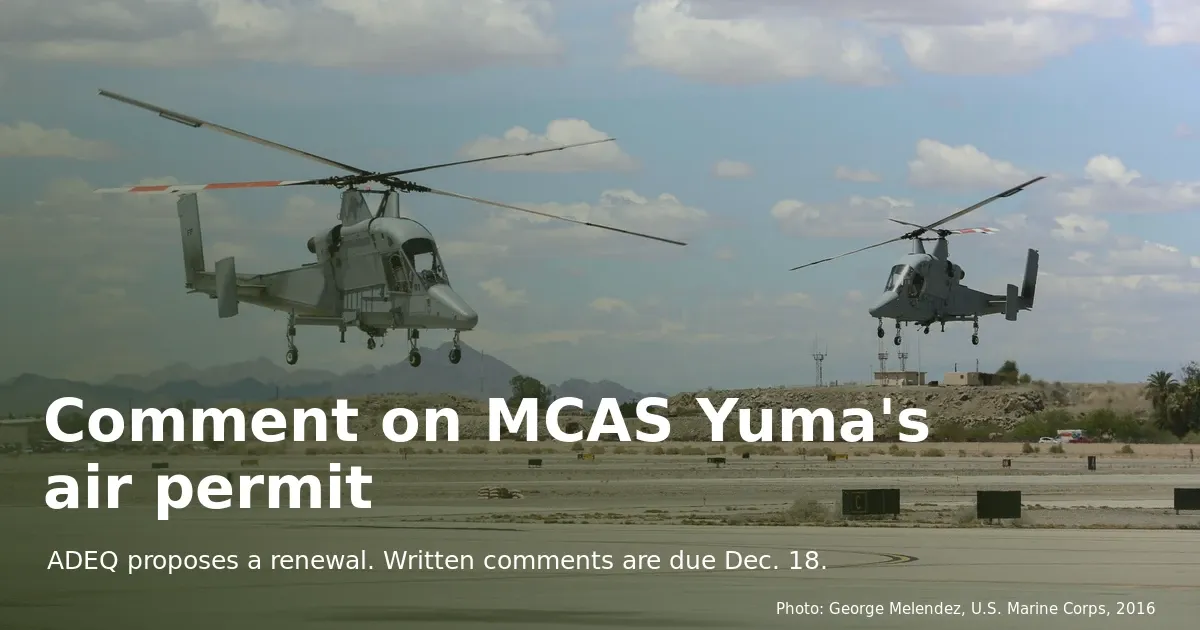
You can comment on MCAS Yuma's air permit renewal through Dec. 18
ADEQ proposes to renew the air station's air-quality permit. Here's how to comment by Dec. 18.
Founder & Publisher
- Published
Full article
The Arizona Department of Environmental Quality is proposing to renew the air-quality permit for Marine Corps Air Station Yuma. The public comment period opened Nov. 18.
Deadline: Written comments must be received by Friday, Dec. 18.
Permit: Proposed Air Quality Control Renewal Permit 112144, for the Marine Corps' continued operation of MCAS Yuma on Avenue 3E.
How to comment
According to ADEQ's notice:
- Email: airpermits@azdeq.gov
- Mail: Karla Murrieta, Air Permits Unit, ADEQ, 1110 W. Washington St., 3415A-1, Phoenix, AZ 85007
- Include your name and mailing address, and your signature or that of your agent or attorney.
- Give your reasons the permit should or should not be issued under the state's air-pollution rules.
- You have a right to request a public hearing.
You can read the draft permit and ADEQ's technical support document online. Copies are also listed at the Yuma City Clerk's office, One City Plaza.
What's in the paperwork
The public notice lists the kinds of pollution the station's operations put out: particulate matter (PM10 and PM2.5), volatile organic compounds, nitrogen oxides, sulfur dioxide, carbon monoxide and hazardous air pollutants.
ADEQ's technical support document goes further. It compares the draft with the station's current permit, No. 87288, describes proposed changes to permit conditions and records past compliance reviews.
Its emissions table estimates the station's potential to emit volatile organic compounds would go from 26.94 to 27.90 tons per year. ADEQ attributes that to a gasoline dispensing facility and fuel tanks. The table estimates lower potential for the other listed pollutants, including nitrogen oxides. ADEQ attributes those reductions to removing jet-engine test cells and welders.
Potential to emit is a calculation of what the permitted equipment could put out. It isn't a measurement of what the station actually emits. And the document doesn't address health effects.
One more thing to know. A separate section of the same document, on nearby schools and learning sites, says emissions did not increase. That reads differently from the small VOC increase in the table. They may be measuring different things. We haven't asked ADEQ to explain it, and we won't guess.
This is separate from the county's PM10 dust rules we wrote about earlier.
Where this comes from
- ADEQ public notice, Nov. 18. Official record. Link
- ADEQ draft permit 112144. Official record. Link
- ADEQ technical support document, sections on emissions, changes to the current permit and learning site evaluation. Official record. Link
- ADEQ public notices page. Link
Earlier coverage: Yuma's dust rules and the county's pushback
Sources 4
- Primary source · Government recordADEQ draft permit 112144
Source cited in the November 20, 2026 Yuma Informed publication.
- Primary source · Government recordADEQ public notice
Source cited in the November 20, 2026 Yuma Informed publication.
- Primary source · Government recordADEQ public notices page
Source cited in the November 20, 2026 Yuma Informed publication.
- Primary source · Government recordADEQ technical support document
Source cited in the November 20, 2026 Yuma Informed publication.