News
Yuma Proving Ground Establishes Permanent Counter-Drone Test Lanes
Yuma Proving Ground has permanent counter-drone test lanes. What the September exercise proved, why Yuma was chosen, and what remains unknown locally.
Founder & Publisher
- Published
Full article
Yuma Proving Ground Establishes Permanent Counter-Drone Test Lanes
Falcon Peak 26.2 ended September 25, but its work at Yuma Proving Ground didn't leave with the exercise. The Army established permanent counter-drone testing lanes at an installation already designated as its primary dedicated interagency range for testing and training against small drones.
For Yuma County, that puts an existing military installation at the center of a continuing effort to figure out which systems can find a threatening drone, identify it and stop it safely. What it does not establish is how many local jobs the program will create or how much money will be spent here. Those numbers have not been published.
Why the testing landed in Yuma
U.S. Northern Command and Joint Interagency Task Force 401 organized Falcon Peak 26.2, which ran from August 31 through September 25 in support of Joint Task Force Southern Border. It was the fourth Falcon Peak experiment and the first held at Yuma Proving Ground. Breaking Defense reported that the Department of Homeland Security and the Defense Innovation Unit also took part.
The location was not incidental. Northern Command built the exercise around the southern border's particular problems, with an emphasis on stopping drones while limiting harm to people and property nearby.
Brig. Gen. Matthew Ross, the task force's director, pointed to Yuma's range instrumentation as a major advantage: developers can measure how their equipment actually performs and get feedback to improve it. The September 27 exercise summary says companies can keep using the lanes without waiting for another Falcon Peak.
Yuma also offers the conditions found near the border. Heat, wind and blowing sand punish equipment that might perform fine under easier circumstances.
The expansion follows an August Army announcement opening the West Cibola Range at Yuma Proving Ground to private industry research and testing. Companies do not need an existing federal contract to request access.
What the border numbers mean
Reuters reported October 5 that Brig. Gen. Brian Filler, deputy commander for operations at Joint Task Force Southern Border, said the military had detected 378 drone incursions during the previous 30 days. He described mostly commercially available drones carrying surveillance cameras, often spotted alongside cross-border movements.
That is a reported southern-border detection count, not a count of incidents in Yuma County. The article offers neither a county breakdown nor evidence identifying the operator of every drone. It also does not establish that 378 different aircraft were involved.
Contemporaneous reporting places the officials' remarks at the September 24 media visit, so the rolling period should not be treated as the 30 days before Reuters published its story.
Military officials describe surveillance supporting smuggling and human trafficking as the predominant border threat. Lessons from Ukraine are shaping the push to improve defenses, but officials told Reuters that cartel drones are not the same as the more sophisticated aircraft used in overseas conflicts.
Finding a drone is only the start
Detection means recognizing that something is present. Tracking follows its movement. Identification helps establish whether it is a drone, what it is doing and whether it poses a threat. A sensor alert alone does not answer all of those questions.
Electronic defeat can interfere with a drone's control or navigation signals, potentially forcing it to land or turn back. Physical defeat uses an interceptor or ammunition to damage or destroy it. High-energy lasers are another option, using concentrated energy rather than a projectile. Each approach carries different limitations and different consequences for the surrounding area.
The official industry roster named 21 participants, including Anduril, Teledyne FLIR, Allen Control Systems, Cover Tech, Genesis Arms and Harmattan AI. Their involvement was a chance to demonstrate and evaluate equipment, not proof that each received a government contract.
Anduril's Lattice software served as the exercise's baseline for evaluating how sensors and counter-drone systems work together. The Army described that as a testing deployment.
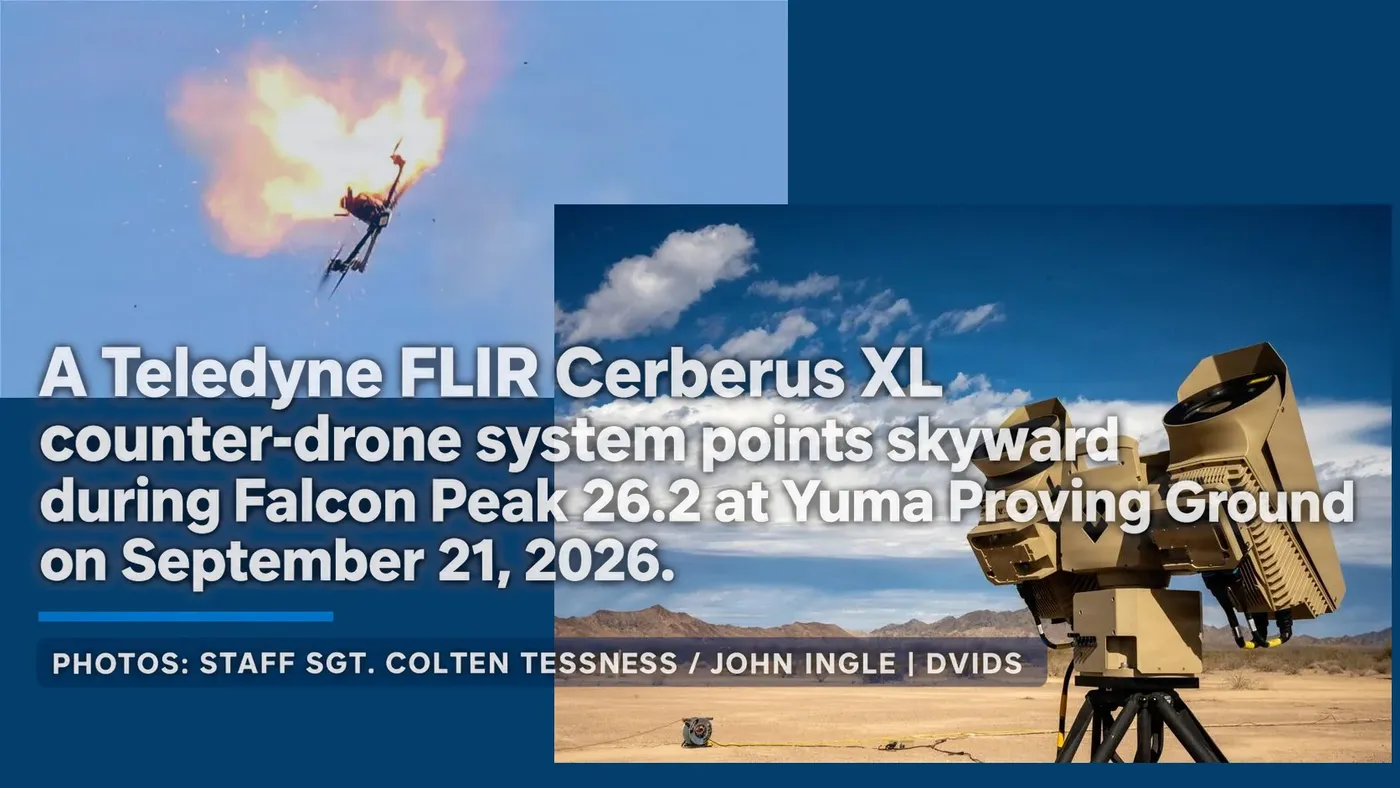
Teledyne FLIR's Cerberus XL was photographed at the exercise. The manufacturer describes a system combining radar, conventional and infrared cameras, radio-frequency detection and mitigation, and command software. Those are product specifications, not an independent account of everything the Yuma demonstration achieved.
There are some documented results. A September 16 DVIDS photograph identifies a destroyed DJI Mavic struck by Cover Tech's Drone Bullet. Breaking Defense reported witnessing three test drones brought down by Genesis Arms' GEN-12 shotgun.
Those examples demonstrate particular engagements. They do not establish an overall success rate. The official exercise summary says performance data went into a centralized repository to inform acquisition decisions; it does not publish a complete vendor-by-vendor scorecard.
Testing, deployment and the money
Some technology tested in Yuma has already reached border operations. AeroVironment said its Army Multipurpose High-Energy Laser prototypes underwent government acceptance testing at Yuma Proving Ground before delivery in 2025. Northern Command reported that the system entered border operations August 24, 2026, and had defeated 11 drones it assessed as cartel-linked by September 4. That is an attributed military account of operational use, not evidence that all Falcon Peak systems were deployed.
CACI says its SkyValor system is slated for deployment. The company announced a three-year counter-drone contract with a $500 million ceiling in July. Its August financial report said SkyValor had been awarded a contract for southern-border deployment after testing at Marine Corps Air Station Yuma, a different installation. The contract award is documented; whether that deployment was completed is not.
Large contracts, by themselves, do not establish local spending. The Army's broader Anduril enterprise contract allows purchases totaling up to $20 billion over 10 years. Neither that ceiling nor CACI's $500 million ceiling is the cost of Falcon Peak or a commitment to spend that amount in Yuma County.
The reviewed announcements provide no program-specific local employment forecast, economic-impact estimate or itemized construction budget. Permanent here describes the test lanes and continuing access; the reports do not describe a separately funded new building project. They also provide no confirmed date for another Falcon Peak at Yuma.
The testing lanes are in place, and companies can return without waiting for another Falcon Peak exercise. How often they'll come back, what they'll test and whether any of that activity translates into local jobs or spending remain unanswered questions.
Sources 16
- Primary source · Government recordArmy opens premier test ranges to private industry for rapid innovation
Army names West Cibola Range among commercial-access ranges, describes large land/airspace and says vendors do not need a prior federal contract to request access. Capacity limits apply; quarterly event discussed in the release concerns Camp Grayling, not a confirmed Yuma schedule.
- Primary source · Public statementAV Delivers First Two Multi-Purpose High Energy Laser Systems to U.S. Army
AeroVironment reports government acceptance testing of AMP-HEL prototypes at Yuma Proving Ground before delivery and soldier training. Historical vendor account, separate from Falcon Peak 26.2.
- Secondary source / research lead · News reportBattling sand and wind, Pentagon evaluates counter-drone tech at southern border exercise
Carley Welch reports firsthand exercise observations, DHS and Defense Innovation Unit participation, heat/sand/wind conditions, three GEN-12 test-drone takedowns, and September 24 border statistics. Its 15 engagement figure differs from KYMA's 12; neither engagement count is reproduced as settled fact in this article. Demonstration outcomes are not overall success rates.
- Primary source · Public statementCACI Fiscal 2026 Fourth Quarter Results: SkyValor southern-border deployment award
Company financial report specifically describes an award to deploy SkyValor along the southern border after two-day JIATF-401 evaluation at MCAS Yuma. Does not independently establish completed fielding or September Falcon Peak involvement.
- Primary source · Public statementCACI Secures $500M C-UAS IDIQ Contract; SkyValor Selected as First Task Order for JIATF-401 Domestic Shield
CACI reports three-year $500 million IDIQ and first SkyValor task order after evaluation at Marine Corps Air Station Yuma. Ceiling is not obligated spending, Falcon Peak cost or local economic impact. MCAS Yuma differs from Yuma Proving Ground.
- Primary source · Government recordDepartment of War Announces Industry Participants in Falcon Peak 26.2
Official roster lists 21 companies. Participation establishes evaluation involvement, not a government contract award. Participants: Allen Control Systems, Anduril, BioRes, Cover Tech, CX2, DataShapes AI, Digital Force Technologies, Drone Matrix, EOS Defense, General Radar, Genesis Arms, GT Aeronautics, Harmattan AI, Helix Defense, Lumenier, Perennial Autonomy, Perseus, PowerUS, Protora, Teledyne FLIR, Zenith Aerotech.
View 10 more sources
- Primary source · Government recordFalcon Peak 26.2: Innovation Continues, destroyed test drone, DVIDS image 9948335
Official Staff Sgt. Colten Tessness caption identifies destroyed DJI Mavic struck by Cover Tech Drone Bullet at Cibola Range Site 17. Documents one engagement, not a denominator or overall intercept rate.
- Primary source · Government recordFalcon Peak 26.2: Teledyne FLIR Cerberus XL, DVIDS image 9955569
Photographer John Ingle; September 21, 2026; VIRIN 260921-D-TH920-5461; original listed 8256 x 5504. DVIDS marks public domain subject to copyright-page restrictions, including non-endorsement and retained third-party rights. User authorized public 2000w derivative because original download requires a validated account. Downloaded file is 1999 x 1333, not original. Caption gallery numbering is inconsistent, so identity is based on photo ID and VIRIN.
- Primary source · Government recordJIATF-401 and NORAD / NORTHCOM Conclude Falcon Peak 26.2, Establish Enduring Counter-UAS Test Lanes
Official summary by Lt. Col. Adam Scher. Ross identifies range instrumentation and continuing access as advantages. Standardized data goes into a central repository. No complete public comparative results, construction budget or dated next Yuma exercise is supplied.
- Primary source · Government recordJoint Interagency Task Force 401 publishes counter-drone handbook
Official explanation of layered defense, shared terminology, training and permissions. No single technology is a universal solution. Linked PDF could not be retrieved; do not claim to have read its detailed contents.
- Secondary source / research lead · News reportReuters: US Army tests counter-drone tech at Mexican border as cartel drone use rises
Reuters report by Mike Blake, writing Joe Brock, editing Rosalba O'Brien, verified through the complete syndicated AOL text. Filler attributed 378 incursions to the previous 30 days, border-wide. No county breakdown, unique-aircraft count, individual operators or independently substantiated universal cartel attribution. Publication date is not the endpoint of the September briefing window.
- Primary source · Public statementTeledyne FLIR Cerberus XL C-UAS product specifications
Manufacturer describes radar, electro-optical/infrared cameras, RF detection and mitigation, and command-and-control integration. Product claims and configurations do not independently establish September exercise performance.
- Primary source · Government recordU.S. Army awards enterprise contract for IT commercial solutions
Official Army announcement of Anduril enterprise contract, five-year base and five-year option, estimated up to $20 billion. Broad framework consolidates procurement actions; not Falcon Peak cost, obligated local spending or guaranteed purchases.
- Primary source · Government recordU.S. Army Yuma Proving Ground hosts major counter-UAS test event
Army account confirms permanent lanes, primary interagency range designation, realistic scenarios and Lattice test-and-evaluation baseline. Does not give local cost, hiring numbers or a complete performance scorecard.
- Primary source · Government recordUSNORTHCOM Operational Update: Cartel Drone Defeats at the Southern Border
Official JTF-SB account says AMP-HEL first employed August 24 and 11 assessed cartel-linked UAS defeated as of September 4. Attributed operational claims, no Yuma County locations or public evidence identifying each aircraft operator. Search-indexed primary release reviewed; direct HTTP access restricted.
- Primary source · Government recordUSNORTHCOM, JIATF-401 Launch Falcon Peak 26.2 Experiment at Yuma Proving Ground
Official announcement specifies August 31 to September 25, fourth Falcon Peak and first at YPG, southern-border conditions and low-collateral defeat goals. Search-indexed primary text reviewed; direct HTTP access was restricted.