News
Yuma Approves $1.31 Million to Replace Jackrabbit Mesa Sewer Lift Station
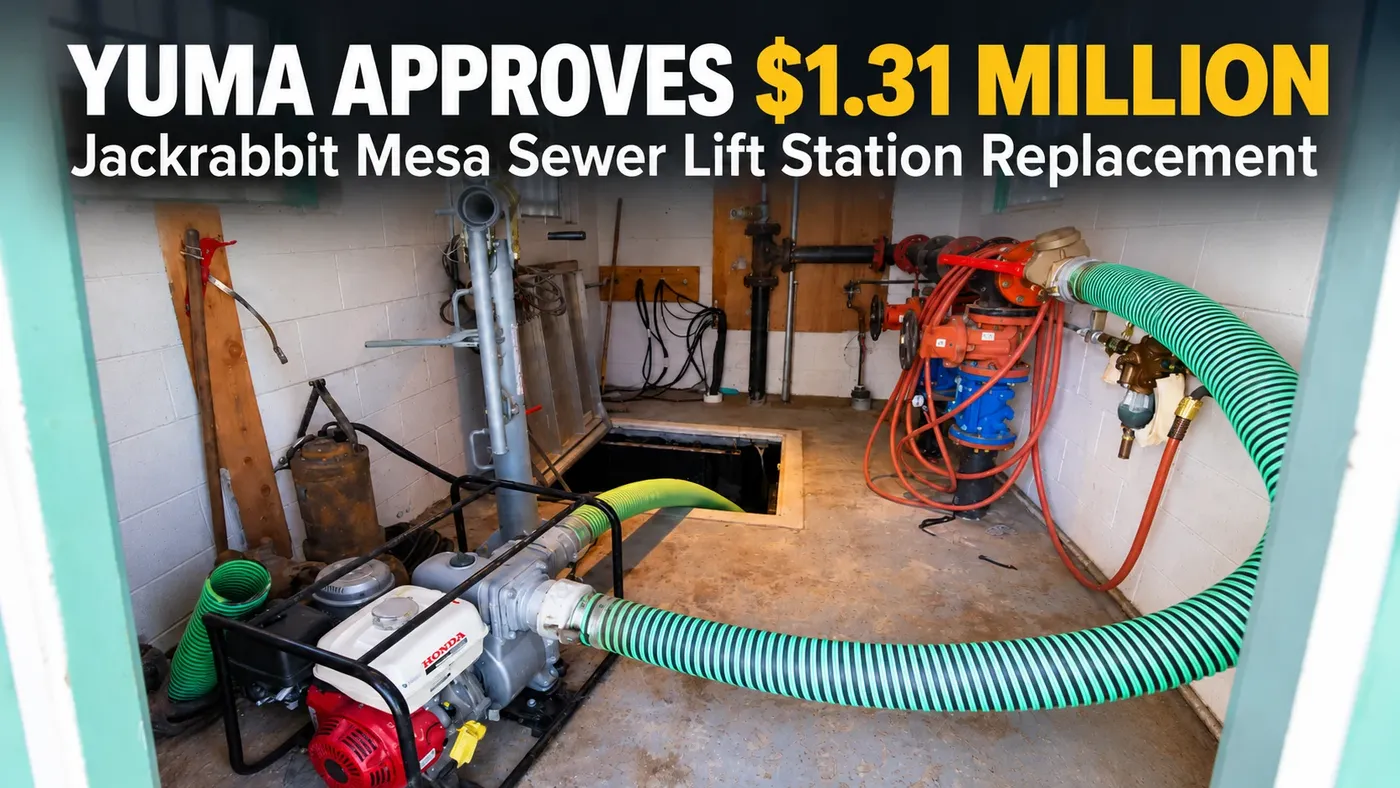
Yuma approved a $1.31 million Jackrabbit Mesa sewer lift station replacement to address pumping and capacity needs, with construction anticipated November to March.
Founder & Publisher
- Published
Full article
Yuma Awards $1.31 Million Contract to Replace Jackrabbit Mesa Sewer Lift Station
Yuma City Council approved a $1,311,837.99 construction contract on October 7 to replace the Jackrabbit Mesa sewer lift station. Kay Constructors LLC of Goodyear submitted the lowest of four bids. The city expects work to begin by November 2026 and finish by March 2027.
The city's 2023 master plan explains the need. It lists Jackrabbit's existing pumping capacity at 315 gallons per minute and recommends increasing it to 1,160 gallons per minute because projected 2027 flows exceed the station's existing capacity. That is a planning recommendation, not a confirmed specification for the equipment Kay will install. (City wastewater master plan)
The job replaces equipment that moves sewage toward Desert Dunes for treatment. It does not build a new wastewater treatment plant. (Council award record)
Three stations, one pressure problem
A lift station pumps wastewater where gravity alone can't carry it onward. Its discharge pipe, called a force main, moves sewage under pressure. Boosting pumping capacity means moving more wastewater through the collection system, not adding treatment at Jackrabbit Mesa. (EPA lift station explanation)
The 2023 Integrated Water Resources Master Plan puts Jackrabbit Mesa on 24th Street between Otondo Drive and Avenue 9E. The station is part of the Desert Dunes service area and repumps flows from Terrace at the View. From there, wastewater heads toward an 18-inch gravity sewer on Avenue 9E, south of Stetson Street, and on to Desert Dunes.
The pressure system also takes flows from the Coyote Ranch lift station and the station at Agua Viva Water Treatment Facility. The problem is what happens when the pumps run together. According to the master plan, Jackrabbit and Agua Viva cannot overcome the pressure created by Coyote Ranch while its pumps are operating. Agua Viva, the plan says, is approaching the point where its pump cannot push water forward when both other stations are pumping.
The documents establish a capacity and pressure problem. They do not establish a sewage overflow or a neighborhood service failure. (City wastewater master plan)
The award covers decommissioning the existing lift station, abandoning the current headworks in place, and building a new lift station, force main, manholes and gravity sewer line. Headworks are the inlet facilities that receive incoming wastewater. (Council award record)
An old treatment site, a new conveyance role
Yuma acquired Jackrabbit Mesa in the 1990s. The site once treated wastewater, but today it serves as part of the pumping system that carries sewage to Desert Dunes. City capital plans confirm Jackrabbit no longer contributes treatment capacity. (Earlier capital estimate) (Adopted capital plan)
The growth connection is documented. The master plan models future wastewater demand and identifies the Jackrabbit upgrade as a response to projected capacity limits. It does not identify this construction award as infrastructure for a particular new subdivision.
What the contract buys
The other bids came in at $1,430,626.41 from Gutierrez Canales Engineering, $1,686,580 from DPE Construction Inc., and $1,955,190.02 from Taylor Engineering PLLC. The council action identifies the funding as 2025 CIP bonds through the Wastewater Fund. (Council award record)
The adopted FY2027 capital plan allocates $1.5 million to construction and maintenance for project 0031-SEWER, funded by wastewater bonds. The award comes in $188,162.01 below that allocation. That's budget room, not a demonstrated saving on the whole project. (Adopted capital plan)
The earlier $1.27 million estimate included $70,000 for design and $1.2 million for construction and maintenance. The new award exceeds that earlier construction allowance by $111,837.99, about 9.3 percent. That comparison alone doesn't establish a like-for-like cost increase, because the final bid scope and the earlier estimate haven't been reconciled. (Earlier capital estimate)
The FY2027 budget lists the replacement station's design among completed accomplishments. The reviewed records don't itemize actual design spending, inspection costs or other earlier expenses, so the construction award shouldn't be read as the project's complete lifetime cost. (FY2027 adopted budget)
A separate capital project proposes replacing roughly 10,500 feet of the Jackrabbit-to-36th Street force main with a larger pipe. Its $4.609 million plan schedules funding in FY2030 and FY2031. That longer pipeline upgrade shouldn't be folded into this contract without evidence the scopes overlap. (Adopted capital plan)
The question the contract doesn't answer
Construction is expected to run from November 2026 through March 2027. The council's award record does not explain how wastewater will continue moving through the system during construction. (Council award record) (City procurement record)
The city expects the replacement to improve pumping capacity and pressure across the system. But the council's award record does not specify the new station's pumping capacity or explain how it will perform when the three stations operate together. Those details will determine how closely the finished project addresses the limitations identified in the city's master plan.