Analysis
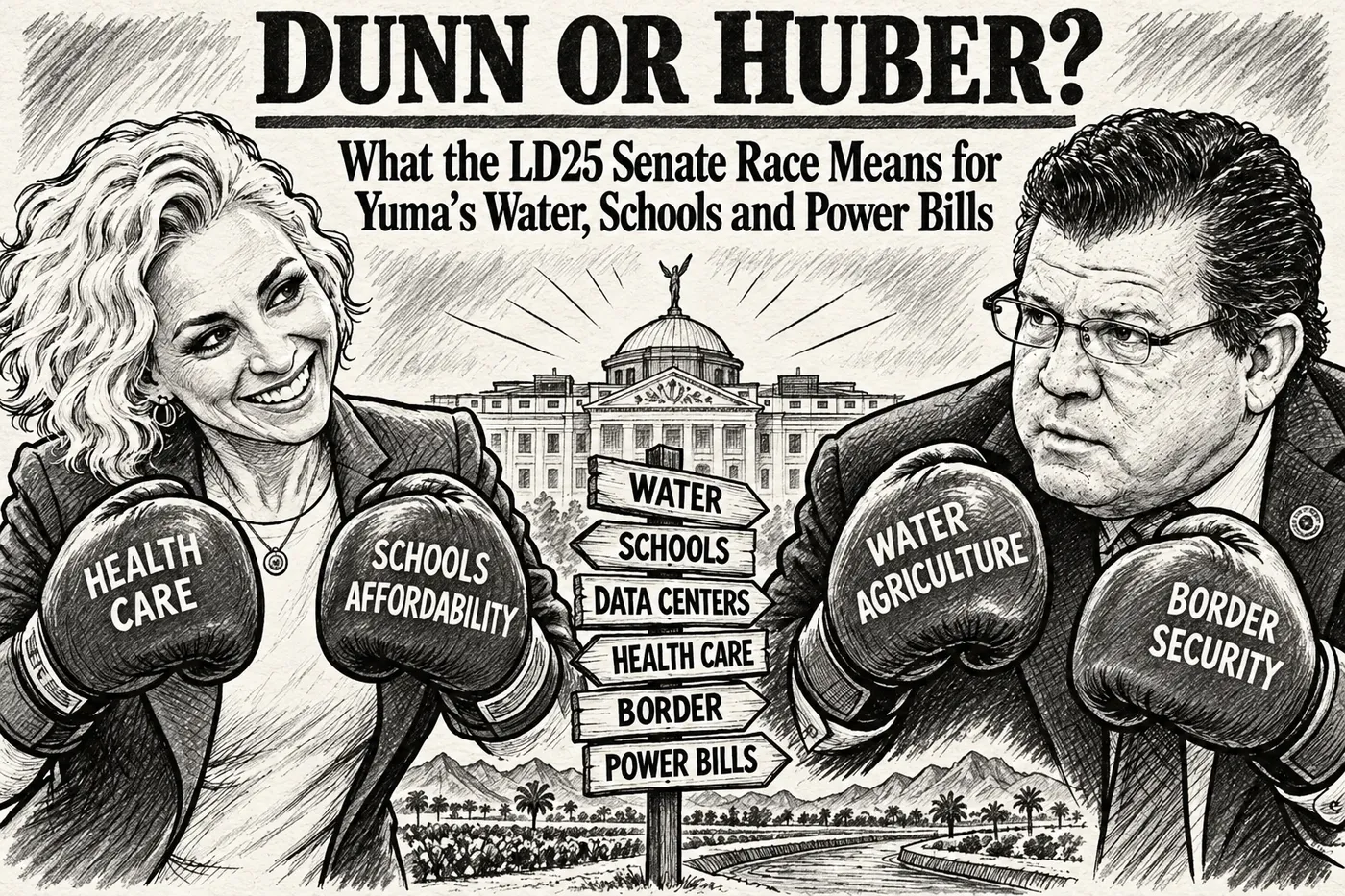
Dunn or Huber: What the LD25 Senate Race Means for Yuma's Water, Schools and Power Bills
Compare Tim Dunn's legislative record with Laura Huber's proposals on water, schools, health care and development in Arizona's LD25 Senate race.
Founder & Publisher
- Published
Full article
Tim Dunn vs. Laura Huber: LD25's Choices on Water, Schools and Growth
Tim Dunn helped expand Arizona's school voucher program to all eligible students. Laura Huber wants to restrict it again.
That is one of the clearest disagreements between the two candidates seeking Arizona's Legislative District 25 Senate seat on November 3. On water, data centers, health care and state spending, the differences are less straightforward.
Dunn, the Republican incumbent, has a legislative record voters can examine. Huber, his Democratic challenger, has published an extensive list of policy proposals, many of which would require new laws, additional funding or cooperation from agencies beyond the Legislature.
For Yuma residents, those distinctions matter. The next senator will have a voice in decisions affecting Colorado River water, agricultural research, school funding and the cost of bringing major new developments onto the electric grid.
The Secretary of State's general-election roster identifies Dunn and Huber as the candidates. Neither is listed as withdrawn, and the state's published withdrawal and write-in list identifies no Senate write-in candidate for the district.
LD25 covers portions of Yuma and Maricopa counties, not all of Yuma County. Residents can find district information through Yuma Informed's 2026 Election Center.
The two candidates
Dunn entered the Arizona House of Representatives by appointment in 2018. His legislative biography describes him as a lifelong Yuma resident involved in the agricultural business Dunn Grain. His 2026 financial disclosure also identifies agricultural business interests.
He now serves in the Senate as vice-chair of the Natural Resources Committee and sits on the Education and Military Affairs and Border Security committees, according to his legislative profile.
Huber operates Mindful Mountain Counseling. Arizona's professional licensing directory lists her counselor license as active, and her financial disclosure identifies mental-health counseling work.
She describes a family history in farming and ranching, along with professional experience in crisis services, hospitals and homeless outreach. Those details come from her own account, also reported by KYMA on October 9.
Their backgrounds help explain the issues each emphasizes. Dunn's work in agriculture and years in the Legislature are reflected in his water and agricultural legislation. Huber's counseling experience is prominent in her proposals for insurance reform and mental-health services.
Neither background, by itself, tells voters how successfully either candidate would represent the district.
Water: shared concerns, different approaches
Both candidates recognize the importance of the Colorado River to Arizona, but neither can promise Yuma farmers a particular amount of water.
In his official general-election statement, Dunn supports a seven-state Colorado River agreement involving the federal government. He also favors agricultural conservation technology and development of additional water supplies.
Huber supports continued negotiations, stronger conservation programs, more efficient agricultural water use, groundwater protection and consideration of new supplies.
There is considerable overlap in those stated goals. The harder questions concern how they would be carried out, who would pay and what authority Arizona could exercise on its own.
Neither candidate's stated position establishes a negotiated river allocation or guarantees a specific supply for Yuma growers. Projects such as desalination would require financing, permits and agreements extending well beyond the authority of one state senator.
Dunn's legislative record offers a clearer picture of his approach to rural groundwater.
His SB1559 in 2026 proposed creating groundwater-basin work groups involving conservation districts, local experts and agricultural producers. Those groups would have developed recommendations for managing groundwater resources.
They would not have imposed enforceable pumping limits.
Dunn sponsored the measure and voted for it when the Senate passed it 16-12. The official bill record lists its final disposition as "Held in House." It never became law.
For rural water users, the distinction is important. A work group can bring local knowledge into decisions about groundwater. It cannot, under this proposal, compel anyone to reduce pumping. Whether that approach provides enough protection is a separate question.
Dunn also sponsored SB1761, which proposed $1.6 million for the University of Arizona's Yuma Center of Excellence for Desert Agriculture, along with additional funding for cooperative extension programs and experiment stations.
The Senate passed the bill 25-1, but it was held in the House.
The proposal demonstrates Dunn's support for agricultural research. It does not establish that the center received the $1.6 million through that legislation. Any funding delivered through separate budget appropriations would need to be examined independently.
Data centers: who pays for the water and electricity?
Data centers introduce another set of questions about Arizona's water supply and electrical infrastructure.
Huber has published proposals aimed at preventing large developments from shifting their operating and infrastructure costs onto existing residents.
Her policy platform calls for allowing local governments to impose annual groundwater withdrawal caps on data centers. She also proposes requiring operators using potable groundwater for cooling to secure renewable water supplies sufficient to offset their withdrawals.
On electricity, she wants grid-capacity certification before major new connections are approved. Developers would be responsible for infrastructure costs attributable to their projects, with long-term contracts, minimum payments and early termination fees intended to protect other customers.
These are proposals, not existing requirements. Huber describes her platform as a starting point for further consultation rather than a finished legislative package.
The details would determine whether the protections worked.
A groundwater offset, for example, would need to be measured and verified. A withdrawal cap would need an agency capable of enforcing it. Long-term utility contracts would need to account for what happens if a developer closes a facility or leaves before its infrastructure has been paid for.
Huber's approach would involve legislation and decisions by water regulators, local governments and utility authorities.
Arizona has already taken some steps toward addressing the electricity side of that problem.
In August, the Arizona Corporation Commission approved a measure intended to prevent customers of specified electric cooperatives from bearing costs created by large new electricity users.
That decision does not establish a statewide requirement covering every utility or proposed data center.
Dunn's published positions and legislative material examined for this comparison did not identify an equivalent proposal addressing data-center groundwater limits, grid expansion or the allocation of infrastructure costs.
That leaves voters without a direct comparison of how he would approach those specific issues. It does not establish that he favors passing the costs to households.
Yuma Informed has previously examined the development question in its reporting on GYEDC and data-center recruitment.
Schools: the clearest disagreement
Education offers one of the sharpest policy differences between Dunn and Huber.
Dunn expressly supports universal Empowerment Scholarship Accounts, commonly called ESAs. The program allows eligible families to use state-funded accounts for approved education expenses outside the traditional public school system.
His position is supported by his voting record.
In 2022, Dunn co-sponsored HB2853, the legislation expanding ESA eligibility across Arizona. He voted yes when the House passed the measure 31-26.
The bill became Chapter 388 after being signed on July 7, 2022. The legislative history documents his involvement.
Huber wants to reverse universal eligibility and restrict ESAs to students with disabilities who qualify for special education or related services.
That would require changing state law, including provisions established by the expansion Dunn supported.
Huber also proposes increasing teacher salaries, recruiting qualified educators and raising Arizona's per-pupil education spending to New York's level within five years.
The difference between those two states is substantial.
According to the National Education Association's 2026 report, Arizona spent an estimated $11,987 per public school student during the 2024-25 school year. New York spent $32,370.
Those totals include education funding from federal, state and local sources.
Matching New York's spending level would therefore represent a major increase, and the comparison cannot be translated directly into a state budget appropriation.
Huber proposes graduated income taxes and other revenue changes to support increased state spending. Her platform, however, does not provide a complete school-funding schedule demonstrating how much her five-year commitment would cost or how the proposed revenue would cover it.
Dunn supports local school control and points to earlier teacher-pay increases. His current published positions do not establish a similarly detailed, quantified plan for teacher recruitment or future compensation increases.
Neither candidate's material examined here provides a sufficiently detailed school career-education plan for a direct comparison.
On ESAs, though, there is little ambiguity. Dunn helped expand the program. Huber wants to narrow it.
Health care: insurance reform and an enacted law
Huber's background in mental-health counseling is reflected in a wide-ranging proposal to change how Arizona regulates health insurance.
She wants to eliminate prior authorization requirements for mental-health and substance-use treatment, strengthen telehealth coverage and establish a prescription-drug affordability board.
Prior authorization is the process through which insurers require approval before covering certain treatments or services. Huber argues that those decisions too often interfere with treatment choices made by patients and clinicians.
Her proposals would shift some of that control through changes to state insurance law.
The limits of state authority are important here.
Arizona insurance regulators identify federal restrictions affecting state oversight of certain employer-sponsored health plans, particularly self-funded plans.
That means state insurance reforms would not necessarily apply to every Arizona resident with health coverage.
Expanding telehealth coverage could help rural patients, but insurance rules alone cannot solve a shortage of available doctors, counselors or other providers.
Huber's proposals would also require legislation, enforcement mechanisms and funding for any new regulatory body.
Dunn's record includes a narrower measure addressing transparency in long-term care facilities.
His SB1564 in 2026 became Chapter 183. Dunn sponsored the measure and voted yes when it passed the Senate 25-3.
The law requires assisted-living facilities and nursing care institutions to disclose their electronic-monitoring practices. The information will be made publicly available through the Arizona Department of Health Services.
The initial disclosure deadline is December 1, 2026.
For families considering a facility, that information could help identify whether residents are permitted to install monitoring devices or whether a facility uses cameras and other monitoring technology.
The law does not require every facility to permit residents to install cameras. It requires disclosure of the facility's practices.
The legislative record confirms its enactment.
The two positions address different parts of health care. Dunn's enacted measure concerns long-term care transparency. Huber proposes broader changes to insurance coverage, payment and affordability.
A comparable current Dunn proposal addressing those broader insurance issues was not established in the published material examined.
Border security, roads and state spending
Border security remains part of Dunn's political platform.
His campaign issues page supports a border wall, immigration enforcement, workplace verification and a monitored legal guest-worker program.
The guest-worker position acknowledges the importance of lawful agricultural labor, an issue with direct consequences for Yuma growers.
Some material on Dunn's campaign page refers to earlier election cycles, so its workforce and spending figures should not automatically be treated as current.
Immigration admissions and federal border enforcement also fall primarily under federal authority. A state senator's ability to change those systems is limited.
Huber's published material reviewed for this comparison does not establish a specific border-enforcement or agricultural guest-worker proposal equivalent to Dunn's.
That is an unanswered policy question, not something that can be resolved by assuming her position from her party affiliation.
On infrastructure, Huber proposes a predictable share of state transportation funding for rural counties, protections for water-related funds and public reporting on broadband construction.
Those proposals address concerns extending across LD25, from agricultural roads in Yuma County to transportation projects in the growing western communities of Maricopa County.
Implementing them would require budget decisions and coordination with the agencies responsible for roads, water projects and telecommunications infrastructure.
A comparable current Dunn package covering those specific proposals was not identified in the material examined.
Neither candidate can establish through campaign statements alone how much funding the next Legislature will approve.
What the campaign-finance reports show
Campaign-finance records provide another way to examine the race, although the reporting dates matter.
The comparable Dunn and Huber reports used for this comparison cover July 1 through July 21, 2026.
Dunn reported $250 in receipts during that period, $1,008.68 in disbursements and $41,400.79 in ending cash.
Huber reported no receipts during the same period, $6,785.91 in disbursements and $36.46 in ending cash.
Those are July balances. They do not show how much either campaign has available in October.
The committees also have different financing structures.
Dunn's traditional campaign committee reported $33,350 in contribution categories to date, along with $13,678.23 in surplus carried over from a previous committee.
Huber's Clean Elections committee reported $5,911.39 in private contribution categories and $23,099 in public funding. Arizona's Clean Elections system provides qualifying candidates with public campaign financing subject to program requirements.
Reported expenditures to date were $43,030.97 for Dunn and $28,700.54 for Huber.
The July reports also show differences in the sources and uses of campaign money.
Dunn's $250 receipt came from Arizona Fairs Industry PAC. Huber's reported spending included advertising and compliance services.
Neither item, by itself, establishes improper influence.
Dunn's reported balance includes $37,403.53 carried into 2025, while Huber's private contributions include $273.39 in noncash support. Those accounting details matter when reconciling cumulative contributions, expenditures and cash balances.
The next quarterly reports cover activity through September 30 and are due by October 15. Those filings will provide a more current comparison of the campaigns' financial positions as the general election approaches.
A record to examine and proposals to test
Dunn and Huber enter this election with different kinds of evidence behind their campaigns.
Dunn has served in the Legislature since 2018. His record includes bills he sponsored, votes he cast, proposals that failed and legislation that became law.
Huber is asking voters to consider what she would do if elected. Her published proposals cover more than the issues examined here, and several contain specific regulatory ideas rather than broad statements of support.
That level of detail gives voters something to evaluate. It does not guarantee that the proposals are affordable, enforceable or capable of passing the Legislature.
Dunn's experience does not automatically establish that his preferred approaches will produce better results, either. His legislative history allows voters to examine what he supported and what actually happened to those measures.
The unanswered questions deserve attention from both campaigns: how much groundwater protection is sufficient, who should pay for new utility infrastructure, how Arizona would finance major education commitments, and what changes to health insurance a state law can realistically deliver.
For the parts of Yuma County within LD25, those are practical decisions with consequences extending well beyond November 3.
This comparison draws on public campaign statements, legislative records and financial disclosures. No new interviews with either candidate were conducted. Where a position could not be established from the examined material, it remains an open question rather than an assumption about what a candidate believes.
Sources 26
- Primary source · Government recordArizona Board of Behavioral Health Examiners: Laura Huber license profile
State directory search on October 12: LPC-14028 Active, expiration August 31, 2028, Mindful Mountain Counseling. LAC-13448 is Closed-Superseded, not her current professional credential. Does not independently establish every campaign career claim.
- Primary source · Government recordArizona Corporation Commission: August 2026 electric-cooperative large-load cost protections
August 12 action announced August 13 concerns specified electric cooperatives. Demonstrates existing regulatory action on cost allocation, not statewide implementation of every Huber proposal or coverage of APS/Yuma projects.
- Primary source · Government recordArizona DIFI: utilization-review regulation and ERISA limitations
Official regulator explanation of fully insured commercial regulation and exemptions including self-funded plans preempted by ERISA. Supports limits on reach, not a definitive legal opinion on proposed bill language.
- Primary source · Government recordArizona Legislature: 2022 HB2853 bill status and House vote
Bill 77976, session 125. House third reading June 22: 31-26, Dunn Y; not prime sponsor. Signed July 7, Chapter 388. Official API response and individual roll call retained.
- Primary source · Government recordArizona Legislature: 2022 HB2853, Chapter 388 universal ESA expansion
Enacted July 7, 2022. Expanded qualified-student eligibility. Dunn co-sponsor, independently checked in historical member profile and introduced text; individual vote checked separately.
- Primary source · Government recordArizona Legislature: 2026 SB1559 groundwater work groups, disposition and votes
Prime sponsor Dunn. Official text requires basin work groups/reports, not binding pumping caps. Senate third reading February 26: 16-12, Dunn Y. FinalDisposition Held in House, no governor action or chapter. Official BillStatusOverview and BillStatusFloorAction API captures retained locally.
View 20 more sources
- Primary source · Government recordArizona Legislature: 2026 SB1564 bill status and Senate vote
Prime sponsor Dunn, Senate third reading March 5: 25-3, Dunn Y. Signed June 19, 2026, Chapter 183. Official individual roll call retained.
- Primary source · Government recordArizona Legislature: 2026 SB1564, Chapter 183 long-term-care monitoring disclosure
Enacted June 19, 2026. Initial disclosure by December 1, 2026 or initial licensure; changes reported; department posts information. Law does not compel all facilities to permit resident-installed cameras. Final enacted text reviewed, not only introduced version.
- Primary source · Government recordArizona Legislature: 2026 SB1761 Yuma agriculture funding, disposition and votes
Prime sponsor Dunn. Proposed $1.6m YCEDA alongside extension/experiment station appropriations. Senate third reading March 16: 25-1, Dunn Y. Held in House, no chapter. Does not establish funding under other budget legislation.
- Primary source · Government recordArizona Legislature: Tim Dunn current Senate committees and sponsorships
Current Legislature 57 profile: Natural Resources vice-chair; Education and Military Affairs and Border Security member. Prime sponsor of 2026 SB1559, SB1761 and SB1564.
- Primary source · Government recordArizona Legislature: Tim Dunn historical House biography and service
Archived Legislature 54 profile confirms first appointed in 2018, lifelong Yuma resident, Dunn Grain agricultural business. Historical biography, not a current independently audited resume.
- Primary source · Government recordArizona Secretary of State: 2026 general write-ins and withdrawals, September 9
Latest PDF linked from the current state election page. No LD25 Senate entry; no withdrawals listed. September 9 document date is disclosed, supplemented by current general roster inspection.
- Primary source · Government recordArizona Secretary of State: 2026 general-election candidate roster
Browser inspection on October 12 confirmed only Timothy "Tim" Dunn (Republican) and Laura Huber (Democratic) in State Senator District 25; neither marked withdrawn and no write-in displayed. Final roster, not merely statements of interest.
- Primary source · Public statementCitizens Clean Elections: 2026 general-election candidate statements, LD25
PDF page 102, printed page 100. Candidate statements reproduced without content verification. Dunn affirms universal ESA, seven-state federal river solution, conservation technology and augmentation. Huber biography supplied by candidate. Funding label Traditional for Huber conflicts with active committee registration and reported CCEC funding; filings receive priority.
- Secondary source / research lead · News reportKYMA: Laura Huber outlines priorities in State Senate race, October 9, 2026
Adrik Vargas reports Huber statements on groundwater, agricultural water security, insurance decisions and data-center infrastructure costs. Career and ancestry remain candidate accounts, not separately proved employment chronology.
- Primary source · Campaign filingLaura Huber active committee: 2026 post-primary finance report
Active Clean Elections committee101997; filed July27, July1-21. Receipts0, disbursements6785.91, cash36.46. Private categories5911.39 include273.39 noncash; CCEC funding23099; total-to-date expenditures28700.54. Distinct terminated committee101996 not merged into totals. General-guide Traditional label does not override registration/funding record.
- Primary source · Public statementLaura Huber campaign: proposals and priorities, reviewed October 12, 2026
Candidate policy page, explicitly preliminary proposals pending further expert consultation. Reviewed water/data-center caps and offsets, grid certificate/cost allocation/ten-year contracts; education spending and ESA limits; insurance/prior authorization/telehealth/drug board; graduated income tax and other revenue proposals; rural roads/water funds/broadband transparency. Figures are candidate claims unless separately verified. No border/guest-worker policy or comparable detailed school vocational plan established.
- Primary source · Campaign filingLaura Huber committee: 2025 cumulative finance report
Amended report records $273.39 in noncash contributions. Removing noncash income reconciles reported cumulative totals to July 21 cash.
- Primary source · Campaign filingLaura Huber: 2026 candidate financial disclosure statement
Signed February 4, 2026. Identifies Mindful Mountain Counseling and mental-health counseling/therapy services and professional licenses. Self-reported filing, supplemented by current state licensure search.
- Primary source · OtherNational Education Association: 2026 educator pay and per-student spending
Primary publication of the NEA dataset, based on education department surveys and other sources. 2024-25 Arizona $11,987/New York $32,370 per pupil. Includes state/local/federal funding; not a costing of Huber proposal.
- Primary source · Public statementTim Dunn campaign: issues, reviewed October 12, 2026
Border wall, enforcement, E-Verify/workplace verification and monitored legal guest-worker program; school choice/local control; water imports/conservation/reuse/technology. Page contains outdated 2024 abortion-election language. Workforce count, border spending and teacher-pay accomplishment totals not independently verified and not adopted as current facts.
- Primary source · Campaign filingTim Dunn committee: 2025 cumulative finance report
Opening cash January 1, 2025 was $37,403.53. Including it reconciles cumulative receipts and expenditures to July 21 cash.
- Primary source · Campaign filingTim Dunn Senate committee: 2026 post-primary finance report
Active traditional committee 101382; filed August 7, covers July 1-21. Receipts250, disbursements1008.68, cash41400.79; total-to-date contribution categories33350, previous committee surplus13678.23, expenditures43030.97. July PAC250 Arizona Fairs Industry PAC. Opening 2025 cash37403.53 from cumulative report must be included in reconciliation.
- Primary source · Campaign filingTim Dunn: 2026 candidate financial disclosure statement
Signed March 15, 2026, covers April 2025-March 2026. Reviewed all extracted pages; agricultural entities include Dunn Grain, Dunn Farms Food Distributing and Tim Dunn Farms. Self-reported interests under perjury certification; no finding of improper influence.
- Secondary source / research lead · OtherYuma Informed: 2026 Election Center
Existing public guide reviewed October 12. LD25 placement was marked unconfirmed; this article separately resolves the roster without modifying the guide. Ballot varies by address and eligibility.
- Secondary source / research lead · News reportYuma Informed: GYEDC data-center recruitment and public records
Existing published Article 18, reviewed in full from authenticated live inventory. Context on public discussion of energy/water/development consequences; does not establish a candidate position.
Related topics 3
- Colorado River Water & Yuma
What federal Colorado River reductions mean for Yuma-area water holders, with evidence on priorities, planning, conservation and unresolved delivery decisions.
- Data Centers in Yuma County
A continuing record of data-center interest, economic-development activity, infrastructure discussions, public meetings and government decisions involving Yuma County.
- Following the Money: Yuma’s 2026 Campaign Finance Audit
A record-based review of publicly posted campaign-finance filings for Douglas Nicholls and Carlos Adams, with calculations and unresolved questions clearly distinguished.