News
Screwworm in Sonora: What Yuma Pet Owners Need Before Crossing the Border
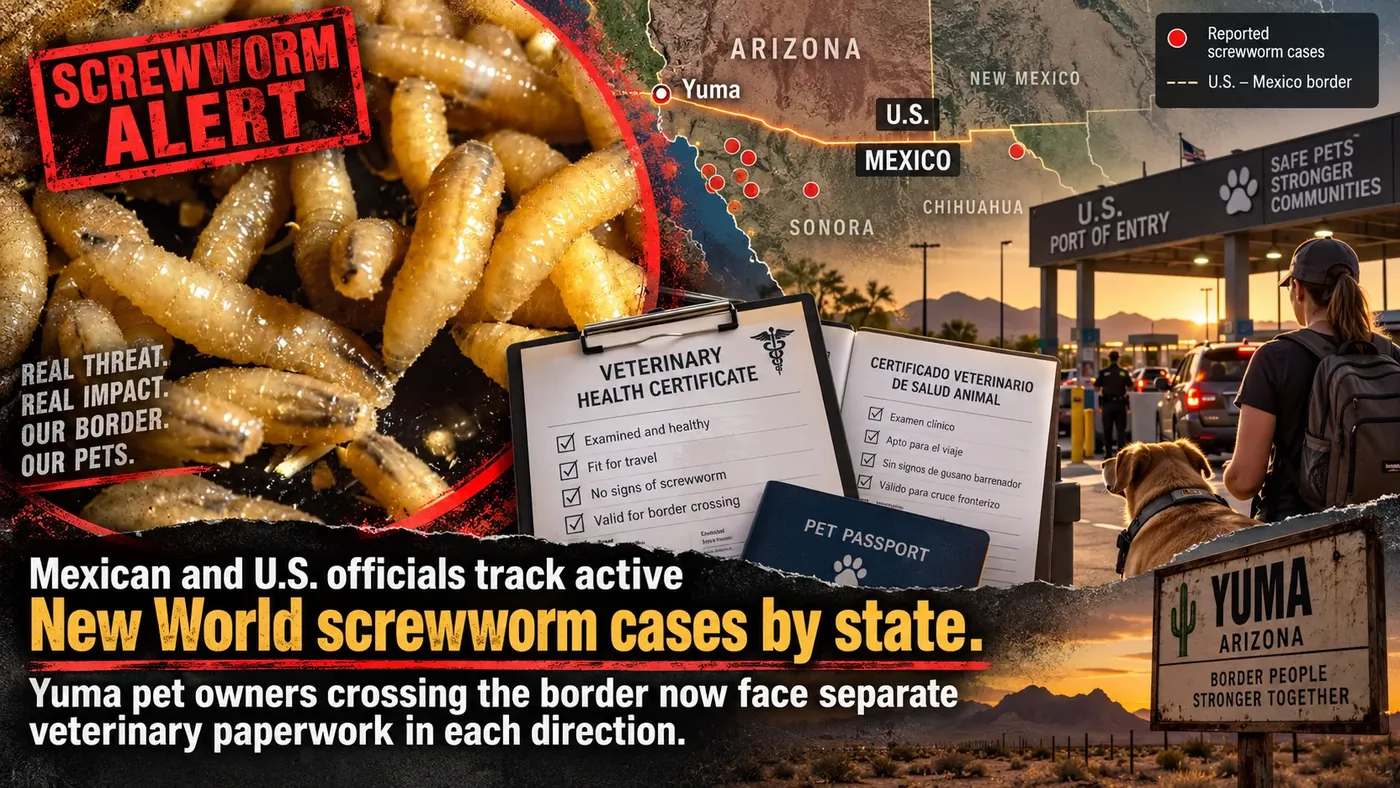
Sonora reports 123 active animal cases while Arizona reports none. Dogs crossing through San Luis need screwworm inspection documents for Mexico entry and U.S. return, under different rules.
Founder & Publisher
- Published
Full article
Screwworm in Sonora: What Yuma Pet Owners Need Before Crossing the Border
Sonora had 123 active animal cases of New World screwworm in the Mexican dashboard reviewed October 11. Arizona reported no confirmed cases. That does not mean Yuma residents can cross the border with a dog and treat the paperwork as optional. Both directions now come with their own veterinary requirements.
The Mexican animal-health agency, SENASICA, gives an October 7 cutoff for those cases and an October 11 update date. The active totals also cover Chihuahua at 149, Sinaloa at 184, Durango at 47, Coahuila at 30, and Nuevo León at 34. These are animal cases, not human infections, and not a running count of everything the outbreak has produced. SENASICA's dashboard carries the reporting dates.
For Yuma County, the immediate issue is preparedness and crossing requirements. The Arizona Department of Agriculture reports zero Arizona cases. That does not predict when or whether the parasite will reach Yuma, and a Sonora-wide total does not identify the closest infested site to the county.
What the confirmed detections show
Arizona Game and Fish issued a September 29 warning after a horse with an infested wound was identified September 17 in Grant County, New Mexico. The agency placed that case roughly 50 miles from Arizona's border. That distance is to the state line, not to Yuma. The warning asked residents to watch livestock, pets, and wildlife.
USDA's U.S. detection dashboard, reviewed October 11, lists the Grant County horse case as inactive. Later entries include an active October 2 dog case in Brewster County, Texas, and an active September 26 goat case in Crockett County, Texas. A September 25 wild-fly detection in Brewster County is listed as inactive. A fly caught in a trap is a different finding from larvae confirmed in an animal. And an inactive animal case does not, by itself, clear the surrounding area of risk.
A wound parasite, with different risks for animals and people
New World screwworm is a fly whose larvae feed on living tissue. Females lay eggs around wounds or body openings, and the larvae burrow into tissue after hatching. Livestock, pets, and wildlife can be affected, including mammals and some birds. Newborn navels and wounds from procedures like castration or dehorning provide the openings.
Watch for wounds that worsen, visible maggots, drainage, foul odor, and changes in behavior such as reduced appetite or isolation. Those signs justify prompt veterinary attention. They do not confirm screwworm. According to USDA's veterinary case definition, identification requires laboratory examination of larvae.
Humans can be infested too. CDC's October 7 situation summary rates current risk to the general U.S. public as very low and reports no locally acquired U.S. human cases. A person who returned from El Salvador in August 2025 had a travel-associated case. CDC recommends covering wounds, using EPA-registered insect repellent, and seeking medical care immediately for a suspected infestation. Animal detections should not be reported as human infections.
Dogs need separate documents for each direction
For dogs entering Mexico from the United States, the requirement took effect August 3, 2026. USDA's current Mexico travel guidance requires the specific screwworm inspection document, signed by a USDA-accredited veterinarian and issued within five days before entry. APHIS endorsement is not required. SENASICA inspectors examine pets on arrival for illness, external parasites, and fresh or healing wounds. A dog without compliant documents can be denied entry or held at the border.
Mexico's official notice says enrollment in its frequent pet-traveler program does not waive the screwworm document. A short visit or a familiar crossing does not remove the requirement either.
The trip home has its own rule. APHIS requires dogs coming from screwworm-affected Mexico, including U.S. dogs returning home, to have certification following inspection within five days before shipment to the United States. A government veterinarian can sign it. In Mexico, a clinical veterinarian trained and authorized to sign on the government veterinarian's behalf can also do so.
The certificate must establish that the dog is free of screwworm, or that it was quarantined and treated until free before departure. APHIS does not require a particular template for this return certification. Officials review documents and inspect the dog at the U.S. port. Do not assume the southbound document covers the return trip.
CDC rules apply as well. For a dog whose previous six months were spent only in rabies-free or low-risk countries, current CDC guidance requires a healthy dog at least six months old, a microchip, and a CDC Dog Import Form receipt. Different travel history can change the requirements. CBP's dog-entry notice points travelers to CDC, and that paperwork does not replace APHIS screwworm certification.
These federal and Mexican requirements apply to San Luis travelers. Before leaving, owners should arrange both inspections and confirm the Mexican veterinarian's authority to certify the return. Yuma Informed has not verified local appointment availability, fees, or an on-site certificate service at San Luis. Do not count on resolving missing papers at the crossing.
Cats entering Mexico do not need the dog screwworm document or a health certificate, but arrival inspection still applies. Do not add cats to the dog inspection form. Returning cats must appear healthy under CDC animal-entry guidance. Birds require species-specific paperwork, including Mexico's screwworm addendum and an endorsed health certificate. Other pets need their own checks.
In Arizona's Family's October 7 reporting, Karina Bazarte interviewed Game and Fish wildlife veterinarian Ann Fann about leaving pets home on Mexico trips. That advice reduces travel exposure and paperwork complications. It is not a blanket prohibition on taking pets across.
Livestock safeguards and reporting
Commercial livestock movements follow separate rules. USDA's current-status page, modified October 7, says Douglas reopened to Mexican cattle imports August 24 with safeguards. Producers should check current port and shipment requirements before moving animals, because reopening decisions depend on outbreak conditions.
Arizona's screening guidance identifies DAO 26-04 for increased screening and tracking of cattle from Sonora, and DAO 26-02 for livestock coming from domestic infested zones. The state describes interagency coordination and surveillance. It also carries the Arizona Cattle Growers Association's support for imports contingent on USDA and Arizona inspection and treatment protocols. No separate Yuma-specific agricultural notice was verified for this article.
CDC's October 7 risk assessment identifies livestock production as the greatest anticipated impact if screwworm is not controlled. It provides no Yuma County loss estimate.
For suspected cases in pets or livestock, contact a veterinarian promptly and the Arizona State Veterinarian's Office at 602-542-4293. USDA reporting guidance also directs animal owners to veterinary and state animal-health officials. Treatment should be directed by a veterinarian.
Report suspicious Arizona wildlife to Game and Fish at 623-236-7201. Do not handle or transport the animal. Note its location and take photographs if safe. USDA Wildlife Services accepts wildlife reports outside Texas at 866-487-3297.
Surveillance, rapid investigation, and releases of sterile flies remain central to the response. The sterile-fly program interrupts reproduction. Official case dashboards and port decisions are the developments to watch. They do not provide a verified arrival date for Yuma.
Sources 17
- Secondary source / research lead · News reportArizona’s Family: Officials urge leaving pets home on Mexico trips
Karina Bazarte’s October 7, 2026 reporting includes Arizona Game and Fish veterinarian Ann Fann’s advice to leave pets home on Mexico trips. Secondary reporting credited for the interview; travel requirements checked against government guidance.
- Primary source · Public statementAZDA: Arizona screwworm status and preparedness
Arizona Department of Agriculture guidance reviewed October 11, 2026. Reports zero confirmed Arizona cases and describes state preparedness and reporting.
- Primary source · Government recordAZDA: Screwworm screening and livestock port reopening
Official Arizona guidance reviewed October 11, 2026. Describes DAO 26-04 cattle screening and tracking, DAO 26-02 domestic infested-zone movement requirements, interagency preparedness, and State Veterinarian reporting at 602-542-4293. Includes Arizona Cattle Growers Association support conditional on inspection and treatment safeguards.
- Primary source · Public statementAZGFD: September 29, 2026 screwworm warning
Arizona wildlife agency warning confirming the September 17 Grant County horse case, approximately 50 miles from the Arizona border, and no detections in Arizona as of the September 29 release. Explains the parasite, wildlife reporting and response.
- Primary source · Public statementCBP: Dog-entry changes and CDC requirements
June 10, 2024 CBP notice explains CDC dog-entry requirements. Historical implementation notice used with current CDC and USDA guidance; it does not replace current screwworm requirements or establish local veterinary service availability.
- Primary source · Government recordCDC: Bringing animals into the United States
CDC animal import guidance reviewed October 11, 2026. Cats must appear healthy at entry and may be examined; the CDC dog paperwork rules do not apply to cats. Other federal and destination-state rules may apply.
View 11 more sources
- Primary source · Government recordCDC: Dogs from rabies-free or low-risk countries
Current CDC dog-entry guidance reviewed October 11, 2026. Healthy dogs at least six months old require a microchip and CDC Dog Import Form receipt. These rabies rules do not replace USDA screwworm certification; travel history can change requirements.
- Primary source · Public statementCDC: New World screwworm situation summary
October 7, 2026 CDC situation summary. Current U.S. public-health risk is very low; no locally acquired U.S. human cases reported. Distinguishes the August 2025 travel-associated human case from animal detections.
- Primary source · Government recordCDC: Screwworm U.S. human-risk assessment, October 7, 2026
October 7, 2026 qualitative assessment rates general U.S. human risk very low and identifies livestock production as the greatest anticipated impact if the outbreak is uncontrolled. Does not provide a Yuma County loss estimate or arrival forecast.
- Primary source · Government recordSENASICA: Active animal screwworm cases in Mexico, October 7 cutoff
Official Mexican dashboard linked by USDA APHIS, reviewed October 11, 2026. Header gives October 7 case cutoff and footer October 11 update. Active animal totals: Sonora 123, Chihuahua 149, Sinaloa 184, Durango 47, Coahuila 30 and Nuevo León 34. These are active animal cases, not human infections or cumulative totals.
- Primary source · Public statementSENASICA: Screwworm inspection rules for dogs and birds from the U.S.
Mexican government August 11, 2026 notice confirms August 3 implementation of five-day screwworm inspection documentation for dogs and birds from the United States. Frequent traveler enrollment does not waive this document.
- Primary source · Government recordUSDA APHIS: Confirmed U.S. screwworm detections
Official U.S. dashboard reviewed October 11, 2026. Lists October 2 Brewster County dog and September 26 Crockett County goat cases as active; September 25 Brewster wild-fly and September 17 Grant County horse detections as inactive. Distinguishes animal and fly detections.
- Primary source · Government recordUSDA APHIS: Dogs entering the United States
Official dog import guidance reviewed October 11, 2026. Dogs from screwworm-affected Mexico, including returning U.S. dogs, need inspection within five days before shipment and certification by a government veterinarian or a Mexican clinical veterinarian authorized to sign on the government veterinarian’s behalf.
- Primary source · Government recordUSDA APHIS: New World and Old World screwworm case definition
Official veterinary case definition explains living-tissue infestation, susceptible animals, wound signs and laboratory identification. Supports the distinction between suspicious wound larvae and a confirmed screwworm diagnosis.
- Primary source · Government recordUSDA APHIS: Pet travel from the U.S. to Mexico
Current Mexico-entry rules reviewed October 11, 2026. Dogs require the specific screwworm inspection document issued by a USDA-accredited veterinarian within five days before entry, without APHIS endorsement. Cats have different requirements; arrival inspection still applies.
- Primary source · Government recordUSDA APHIS: Reporting suspected screwworm cases
Official reporting guidance reviewed October 11, 2026. Animal owners should contact a veterinarian; livestock reports involve state animal-health officials or APHIS. Wildlife reporting outside Texas is available through USDA Wildlife Services at 866-487-3297.
- Primary source · Government recordUSDA APHIS: Screwworm current status and port reopening
Official current-status page, modified October 9, 2026. Confirms Douglas cattle-import reopening August 24 with safeguards, phased port decisions and continuing surveillance and sterile-fly response. Port status can change with outbreak conditions.