News
Questions Surround Sen. Brian Fernandez's AWC Ties Following State Funding and Housing Revelations
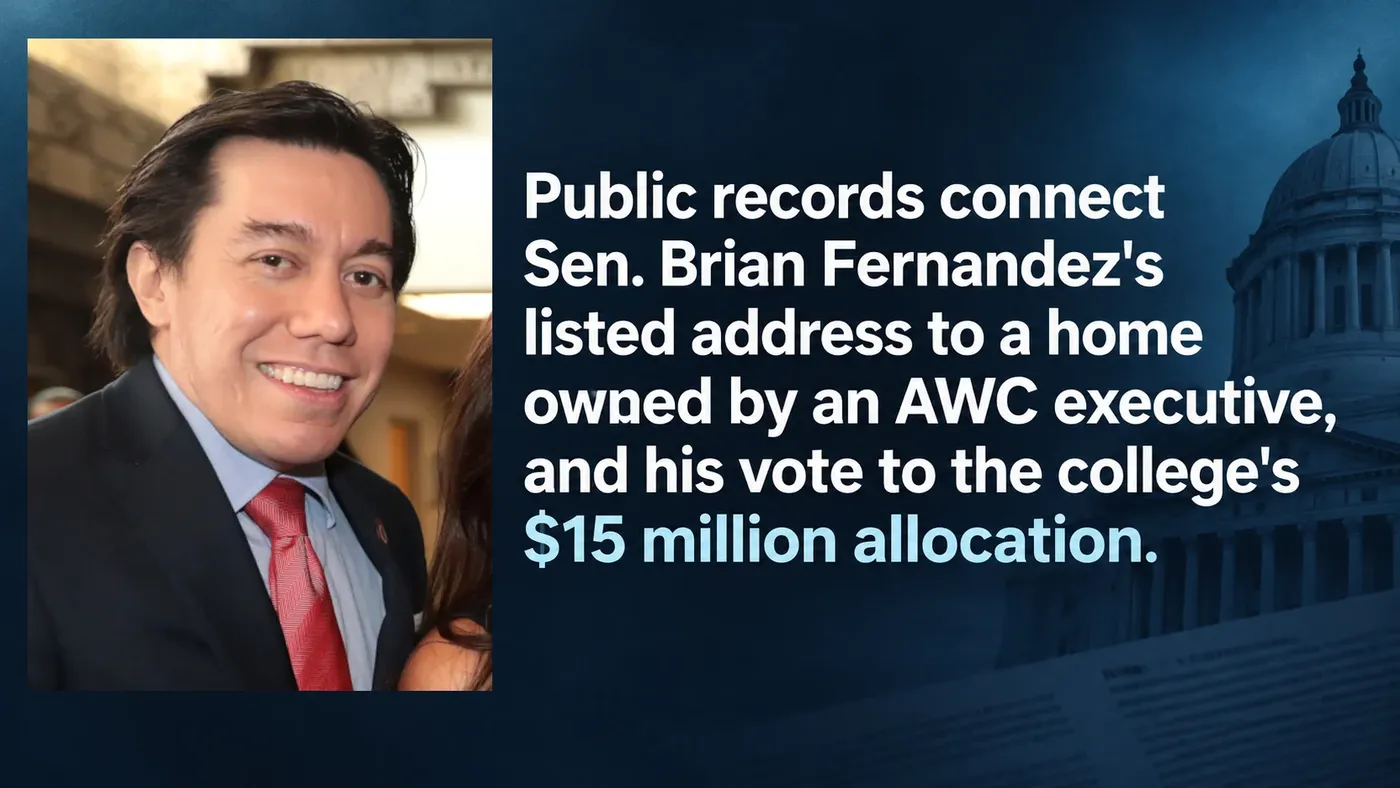
Public records confirm Fernandez’s declared address at a property owned by an AWC executive and a $15 million allocation naming the college. Rent, financial benefits and disclosure compliance remain unresolved.
Founder & Publisher
- Published
Full article
YUMA, Ariz. Arizona Western College was awarded a $15 million allocation specifically named in Arizona’s state budget while Sen. Brian Fernandez, whom the college credited with helping secure the money, listed a Yuma property owned by one of its senior executives as his address.
Public records reviewed by Yuma Informed independently establish the address connection, the appropriation and Fernandez’s vote for the budget. They do not establish whether he pays rent, what any lease requires, or whether the arrangement gave him a financial benefit tied to his legislative work.
The housing questions originate with Laura Gersony’s reporting for The Arizona Republic, described in KAWC’s October 9 coverage and her October 8 KJZZ interview. According to that coverage, Fernandez has listed the home of AWC Vice President for Advancement Lorraine, also known as Lori, Stofft as his residence since his 2021 appointment to the Legislature.
The independently verified record is narrower. It confirms his use of the address in retrieved filings signed in January 2022 and January 2023. It does not establish when he moved in or how often he stays there.
What the property and disclosure records show
Fernandez’s January 25, 2022 financial disclosure, a separately listed January 27 amendment, and his January 13, 2023 statement give the same Yuma address.
The Yuma County Assessor’s public property records list Lorraine Cosette Stofft as owner of the matching property. The assessor’s transfer history also lists her as a grantee in a joint-tenancy deed recorded May 31, 2019. A city-hosted parcel layer, drawn from county assessor data, corroborates the current owner and address match.
The residence’s street address is omitted here. Ownership and a declared address are relevant to the public question; identifying the house for readers adds nothing necessary to it.
The college’s advancement organizational chart identifies Stofft as vice president of advancement and executive director of the AWC Foundation. Her institutional role is documented. The terms of any private housing arrangement are not.
None of the records reviewed proves rent-free housing, a false residence or an exchange of housing for legislative support. A financial-disclosure form also permits a home or work address, so the filing alone cannot prove physical occupancy.
The $15 million was a specific legislative allocation
The enacted FY 2024 budget, SB 1720, includes a $15 million line for AWC’s career and technical education workforce programs. The Joint Legislative Budget Committee’s report identifies it as one-time funding.
This was a direct allocation naming the college. The provision does not establish an open competition in which colleges applied for that $15 million. It sits alongside broader state-aid programs with district allocations and statutory funding formulas.
For the Yuma/La Paz district, the same report lists $716,100 in equalization aid, $2,260,700 in operating aid, $777,700 for STEM and workforce programs, and $4,871,400 in rural aid. Those four lines total $8,625,900. Adding the special $15 million allocation brings the FY 2024 General Fund appropriation total to $23,625,900.
The comparable FY 2023 district lines total $7,263,400. The new allocation therefore explains most of the increase to more than three times that amount. These are legislative allocations, not the college’s entire budget or proof that every appropriated dollar was spent that year.
AWC’s FY 2024 audit reports $8,625,900 under “State Appropriations,” matching the four regular aid lines. It reports grants and other revenues separately and describes a large increase in unearned revenue associated with state Department of Education career and technical education grants. The documents reviewed do not provide a complete reconciliation of the $15 million earmark to receipts, recognized revenue and spending. The different accounting categories are not evidence that money disappeared.
Fernandez’s support is documented; the negotiations are less clear
The Legislature’s official roll call records Fernandez voting yes on SB 1720 when the Senate passed it 25–5 on May 10, 2023. That was a vote on the full budget bill, not a separate vote solely on AWC’s allocation.
The college subsequently credited his advocacy. Its April 24, 2024 announcement says the Fernandez Family Cyber Security Lab was funded as part of the $15 million allocation and credits Brian Fernandez with helping secure a historic level of funding. The lab honored the family, rather than Brian alone.
AWC’s own accounts show a broader legislative effort. A February 2022 release describes outreach to several lawmakers, including Fernandez, by a delegation that included Stofft. A February 2025 release identifies her among college leaders seeking workforce funding from several legislators, again including Fernandez.
The later visit concerned the upcoming 2026 budget. It cannot establish who negotiated the 2023 allocation. The releases document Stofft’s participation in institutional advocacy, but not her precise role in securing the $15 million or whether Fernandez’s housing affected any decision.
What Arizona’s ethics rules require
Arizona law distinguishes a financial conflict from a relationship that raises questions about transparency.
Under A.R.S. § 38-503, an official with a substantial interest in a public-agency decision must disclose that interest in the official records and refrain from participating. Section 38-502 defines a substantial interest as a nonspeculative financial or ownership interest, direct or indirect, excluding designated remote interests. One exception concerns a class of at least ten people when the official’s interest is no greater than that of other members. Simply counting ten beneficiaries is not enough to resolve every conflict question.
The statute also lists a landlord or tenant of a contracting party among remote interests. That language does not automatically resolve an arrangement involving an employee of an institution receiving an appropriation. Its application depends on the parties, the decision and any actual financial stake.
Senate Rule 30, in the 2023–2024 rules, requires a written statement when a senator anticipates official action involving a potential personal financial interest. It goes to the Senate president, Ethics Committee chair and secretary. The rule addresses reasonably foreseeable material financial effects and includes a class exception. The 2025–2026 rules retain that framework. Rule 29 also prohibits accepting a personal financial benefit on an understanding that official action will be influenced.
Annual disclosures are a separate requirement. A.R.S. § 18-444 and the Secretary of State’s guide require identification of a donor whose gifts exceed $500 cumulatively in a year, subject to exceptions. A special discount or benefit received without equivalent value in return can count as a gift. Housing supplied on favorable terms could therefore require examination under those rules; no such terms have been established here. The law also exempts a primary personal residence from the separate real-property-interest listing.
The gift sections in the retrieved 2022 filings and 2023 statement say “N/A.” That establishes what Fernandez reported in those filings. It does not establish that a reportable housing gift existed or was omitted. The newer 2024–2026 annual statements were not retrieved, leaving the disclosure review incomplete.
Gersony said on KJZZ that Fernandez had not disclosed a conflict concerning AWC or Stofft to Senate Republican leadership. That remains attributed reporting: Yuma Informed has not obtained the Senate’s disclosure files or an advisory opinion resolving this arrangement.
The separate Onvida funding decision
The earlier hospital controversy provides relevant context for how Fernandez has handled disclosure questions, but involves different money and a different relationship.
His 2025 SB 1458 proposed an unspecified appropriation to the University of Arizona for a Yuma regional medical center. The enacted 2025 budget instead directed $3 million through the City of Yuma to a nonprofit regional hospital supporting at least 400 beds. The JLBC report identifies that as one-time FY 2026 funding.
City-hosted January 7, 2026 minutes record approval of a mission support agreement with Onvida Health for a rural medical-school branch and medical education. The Legislature’s final SB 1735 roll call independently confirms Fernandez voted for that budget on June 27, 2025.
In Nicole Ludden’s March 13 Arizona Agenda reporting, Fernandez said he worked for Onvida, would receive no material financial benefit from the appropriation, and had abstained on the separate SB 1264 proposal after consulting counsel to avoid an appearance of impropriety. He argued that the same concern did not apply to the broader state budget. Those explanations concern his employer. They do not answer the housing questions involving Stofft.
The unanswered questions
The accessible October coverage reports no answers from Fernandez or Stofft about rent, a lease or ethics guidance. KAWC said on October 9 that it had sought their comments and was awaiting responses. The station also disclosed that AWC holds its license and Stofft oversees KAWC.
The remaining questions are specific: What is the housing arrangement? Did it provide a financial benefit, and if so, how was that benefit valued and disclosed? What role did Fernandez and Stofft each play in pursuing the special allocation, and what ethics advice or written disclosures accompanied his legislative actions?
Public records establish the property connection and substantial funding for the college. They do not establish that the arrangement violated the law. Answers and records concerning the private benefit, if any, are needed before that conclusion can be drawn.
Reporting note: Yuma Informed reviewed accessible coverage and primary records. The paywalled Republic investigation was not reviewed directly. No interviews with Fernandez, Stofft or AWC were conducted for this report.
Sources 29
- Primary source · Government recordA.R.S. § 18-444: annual financial disclosure requirements
Primary statute governing annual financial disclosures, including compensation, gifts and primary-residence exceptions.
- Primary source · Government recordA.R.S. § 38-502: Definitions
Official Arizona Revised Statutes Article 8 text, section 502.
- Primary source · Government recordA.R.S. § 38-503: Conflict of Interest; Exemptions; Employment Prohibition
Official Arizona Revised Statutes Article 8 text, section 503.
- Secondary source / research lead · News reportArizona Agenda: The conflicting interests of Brian Fernandez
Nicole Ludden’s accessible reporting includes Fernandez’s emailed explanations, SB 1264 recusal and an image of his disclosure form.
- Primary source · Government recordArizona Laws 2023, Chapter 133: SB 1720, AWC appropriation
Enacted FY 2024 General Appropriations Act. Section 20 expressly names AWC’s $15 million CTE workforce allocation.
- Primary source · Government recordArizona Laws 2025, Chapter 233: $3 million Yuma hospital allocation
Enacted SB 1735, Section 118(A)(38), provides the separate FY 2026 hospital allocation.
View 23 more sources
- Primary source · Government recordArizona Legislature: final SB 1735 Senate roll call
Official final-passage data independently confirms Fernandez voted for the budget containing the hospital allocation.
- Primary source · Government recordArizona Legislature: SB 1720 Senate third-reading roll call
Official roll-call data independently establishes Fernandez’s affirmative vote on the FY 2024 budget bill.
- Primary source · Government recordArizona Secretary of State financial disclosure guide, 2025
Official guidance on annual filings, gifts and the statutes governing financial disclosure.
- Primary source · Government recordArizona Secretary of State: officeholder disclosure index and annual periods
Official index explains that filing years cover prior calendar-year financial activity and links current and historical filings.
- Primary source · Government recordArizona Senate Rules 2023–2024: Rules 29 and 30
Contemporaneous Senate ethics and personal-financial-interest rules for the AWC appropriation decision.
- Primary source · Government recordArizona Senate Rules 2025–2026: Rules 29 and 30
Current-session Senate rules reviewed for disclosure, advisory-opinion and substantial-interest requirements.
- Primary source · Government recordAWC adopted budget for FY 2023–2024
College budget independently displays the four regular state-aid components matching the enacted district allocations.
- Primary source · Public statementAWC advancement organizational structure, November 2025
College organizational chart identifies Lorraine Stofft’s advancement and foundation leadership role.
- Primary source · Government recordAWC audited financial statements, year ended June 30, 2024
Audited college accounts distinguish recognized revenues from legislative allocation totals.
- Primary source · Public statementAWC: Day at the Capitol, February 2022
College account establishes earlier legislative outreach involving Fernandez and a delegation including Stofft.
- Primary source · Public statementAWC: Fernandez Family Cyber Security Lab announcement
College statement links its new cybersecurity lab to the $15 million allocation and credits Brian Fernandez’s funding advocacy.
- Primary source · Public statementAWC: students and leadership advocate at State Capitol, February 2025
Primary college account identifies Stofft among leadership seeking workforce funding and Fernandez among legislators met.
- Primary source · Government recordBrian Fernandez financial disclosure amendment signed January 27, 2022
Amended disclosure linked separately by the Secretary of State’s 2022 index.
- Primary source · Government recordBrian Fernandez financial disclosure signed January 13, 2023
Secretary of State-hosted Senate financial disclosure reviewed for address, gift and compensation entries.
- Primary source · Government recordBrian Fernandez financial disclosure signed January 25, 2022
Secretary of State-hosted financial disclosure independently reviewed for its address and gift entries.
- Primary source · Meeting recordCity of Yuma City Council minutes, Jan. 7, 2026: RFB-25-283 award
Approved City Council minutes recording the construction-contract award for the 5th Street water distribution line.
- Primary source · Government recordCity of Yuma: County Parcels layer ownership cross-check
City-hosted parcel layer independently corroborates the assessor owner-name and address match.
- Primary source · Government recordJLBC FY 2024 Appropriations Report: Arizona Community Colleges
Primary budget report verifies AWC’s one-time $15 million CTE allocation and district aid components.
- Primary source · Government recordJLBC FY 2026 Appropriations Report: Yuma hospital distribution
Primary budget analysis confirms a one-time $3 million General Fund distribution through Yuma for a qualifying hospital.
- Secondary source / research lead · News reportKAWC: Republic investigation raises questions about Fernandez and AWC
Accessible secondary coverage of Laura Gersony’s Arizona Republic investigation. Credits the original reporting and describes the reported housing connection and requests for comment.
- Secondary source / research lead · InterviewKJZZ: Laura Gersony interview on Fernandez’s AWC ties
Accessible interview with the Republic reporter concerning the reported housing connection, college funding, and unanswered questions.
- Primary source · Government recordSB 1458 as introduced by Fernandez: regional medical center appropriation
Original bill introduced by Fernandez proposes an unspecified appropriation to the University of Arizona for a Yuma regional medical center.
- Primary source · Government recordYuma County Assessor: property ownership and May 2019 transfer entry reviewed
Public EagleWeb assessor records independently matched the address in Fernandez’s retrieved disclosures to property listed under Lorraine Cosette Stofft.