Background
They Fed Them. Then They Fought Them.
On Nov. 28, 1775, Quechan families fed Anza's expedition and helped it cross the Colorado. Less than six years later, the Quechan destroyed both Spanish settlements at the crossing. California's own record says why.
Founder & Publisher
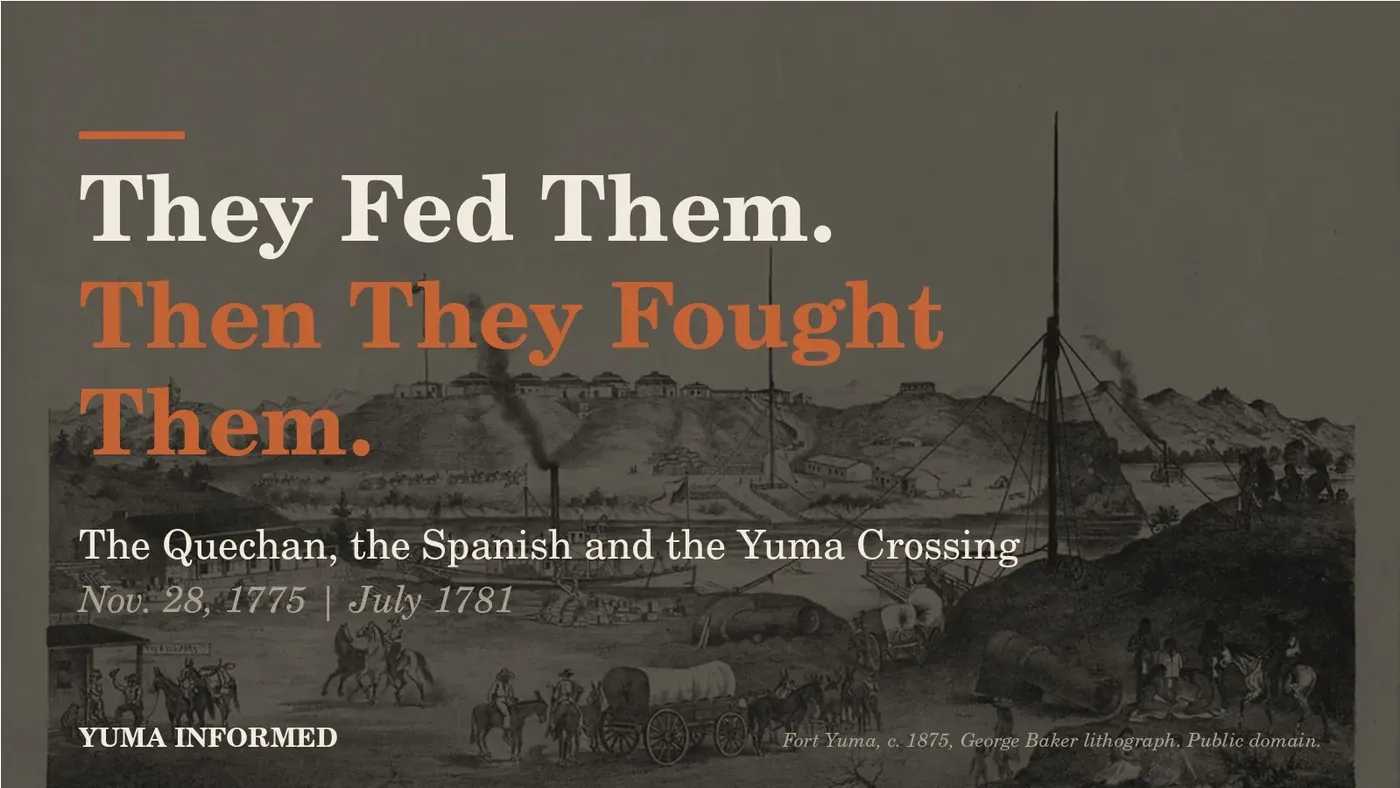
- Published
Full article
On Nov. 28, 1775, Quechan families near where the Gila River runs into the Colorado fed a Spanish expedition.
Beans, squash, corn, wheat. And watermelons. Juan Bautista de Anza, the man leading the expedition, figured there were more than 3,000 of them.
Two days later, the Quechan helped those same travelers get across the river.
In July 1781, less than six years after that meal, the Quechan destroyed both Spanish settlements at the crossing. They killed Spanish settlers, soldiers and missionaries.
What happened in between is written down in California's official landmark record for the site, in the state's own words: “Colonists ignored Indian rights, usurped the best lands, and destroyed Indian crops.”
That isn't an activist group talking. That's the State of California.
Who “them” is
The Spaniards in those two scenes weren't the same people.
Anza's party in 1775 was passing through on its way to settle California. The settlers who put down roots at the crossing came later, in 1780 and 1781.
At least one man was there for both. Father Francisco Garcés came to the Yuma area with Anza in November 1775 and stayed behind when the expedition moved on. He was killed in the uprising in July 1781.
The ask came first
Most of what we know about that week comes from Anza's own diary, translated into English by historian Herbert Bolton in 1931. Anza calls the people here “Yumas.” They're the Quechan, and that's what I'll call them.
The day before the meal, Nov. 27, the Quechan leader Salvador Palma had a question for Anza. In Bolton's translation, Palma “begged me to tell him whether the Spaniards and fathers were now coming.” He asked that Spaniards and missionaries settle there.
That detail matters. This wasn't a lost expedition stumbling into a village. Palma wanted the Spanish to come. He asked for it.
That's Palma's decision, the leader's. The diary doesn't say what every Quechan family thought about it.
The meal
When Anza reached the river Nov. 28, Palma had a large shelter built out of branches waiting for the expedition.
Anza writes that he was met by Palma's wife and family, by the family of another captain and by several others. Then, he wrote, “they invited all members of the expedition to eat.”
Not the officers. All of them.
The list in the diary is beans, calabashes (squash), maize, wheat and other grains. Then the watermelons. “More than three thousand” is Anza's number, and he's upfront that it's a guess. He wrote “we estimated.”
More than 3,000 watermelons. In late November.
Father Pedro Font, a priest who kept his own diary of the trip, wrote about the same day, including the shelter Palma arranged. Font places the junction of the two rivers just downstream from it. Nobody wrote down a street address, and none of the records we checked pin the spot on a modern map. It was somewhere in the Yuma Crossing area.
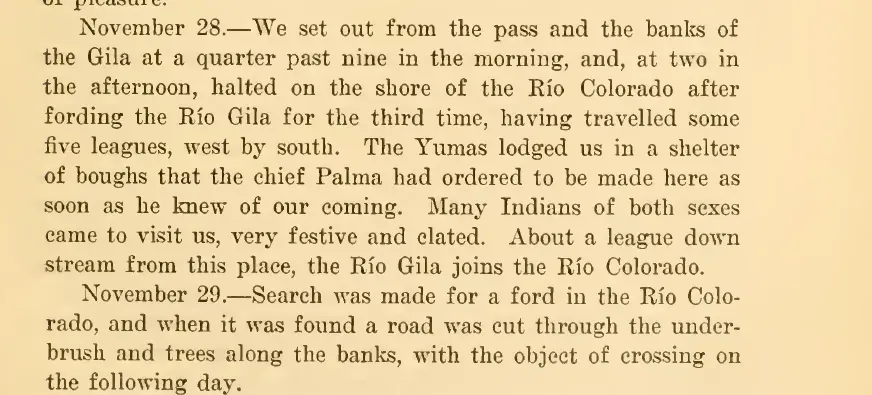
Pedro Font's Nov. 28, 1775 diary entry describes the shelter Salvador Palma arranged for Anza's expedition near the Gila and Colorado rivers. From the 1913 English edition edited by Frederick J. Teggart, p. 31, via Internet Archive / Wikimedia Commons. Public domain in the United States.
The crossing
On Nov. 29, the Quechan told Anza the river had no ford. He ordered logs brought in for rafts. The Quechan objected that it couldn't be done because the water was too cold. Then a ford turned up anyway, a deep one, and Anza wrote that his soldiers were relieved not to cross on rafts after what they'd heard.
The diary says cold. It doesn't give a temperature, so I won't either.
On Nov. 30, the expedition crossed the Colorado in three branches, about 240 yards of river in all. A man carrying a child fell in and was pulled out. Font's account has Garcés being carried across.
Then the expedition went on to California. Garcés and another priest, Tomás Eixarch, stayed.
Is this Yuma's Thanksgiving?
No. The expedition diaries describe a welcome and a meal. It wasn't a Thanksgiving.
It happened 154 years after the Pilgrims' harvest gathering at Plymouth, under a different empire, for different reasons. The meal doesn't predate Plymouth.
What does predate Plymouth is Yuma's first contact with Europeans. The City of Yuma's own history puts it in 1540, “some 80 years before the Pilgrims set foot on Plymouth Rock.” Hernando de Alarcón came up the Colorado by boat. Melchior Díaz came overland.
The Cocopah Tribe's history says Alarcón's men were offered shells, beads, well-tanned leathers and food.
So the first Europeans to show up here got fed too.
What Yuma has is a parallel: a native community feeding newcomers in late November, and then a fight with the ones who came after. The difference is that Yuma's version has the fight written into a state record.
What came next
Garcés helped establish the first settlement, La Purísima Concepción, in October 1780 on the California side of the river. A second, Bicuñer, followed on Jan. 7, 1781.
California's record for Concepción is the line at the top of this story. Colonists ignored Indian rights. They took the best lands. They destroyed Indian crops.
The state's record for Bicuñer says the Quechan were facing the loss of their land when they attacked on July 17, 1781.
Concepción was destroyed between July 17 and 19. Bicuñer went down too.
The Quechan killed Spanish settlers, soldiers and missionaries. The National Park Service names four Franciscan priests among the dead. Garcés was one of them.
How many people died in all? I've seen numbers. I haven't seen one I can trace to an original record, so you won't get one from me here.
Here's what the state says the uprising did: “The Quechan victory closed this crossing and seriously crippled future communications between upper California and Mexico.”
Put it in order and it reads like this. Palma asked for the Spanish. His people fed them and got them across the river. Within six years, by California's account, colonists were taking the best land and wrecking Quechan crops. Then the Quechan ended it.
The national version, quickly
The Plymouth story most of us learned has thinner paperwork than you'd think. Most of it comes from one letter by colonist Edward Winslow. In autumn 1621, about 50 surviving colonists and about 90 Wampanoag men ate together over three days. The Wampanoag brought five deer.
Sixteen years later, the Massachusetts colony ordered a day of thanksgiving, partly “for his great mercies in subdewing the Pecoits.” That's the Pequot, after the Pequot War. The spelling is theirs.
The modern holiday doesn't run through 1637, though. The Continental Congress proclaimed a thanksgiving in 1777. Then George Washington set the first national Thanksgiving under the Constitution for Thursday, Nov. 26, 1789. That's today's date. Abraham Lincoln's Thanksgiving in 1863 also fell on Nov. 26. Congress fixed the fourth Thursday in 1941.
What we still don't know
We couldn't find a Quechan-written account of 1775 or 1781 online. That doesn't mean one doesn't exist. It means we haven't seen it. The meal, the shelter and the crossing come from the expedition's Spanish diaries. The land and crops come from California's landmark records.
We also don't have a death toll we can stand behind, or an exact spot for the meal.
And this story doesn't speak for how Quechan or Cocopah people see Thanksgiving today. That's theirs to say.
The hill
Concepción stood on what's now called Indian Hill. Decades after the uprising, the U.S. Army built Fort Yuma on that same hill. Today, according to California's record, the St. Thomas Indian Mission sits on the site.
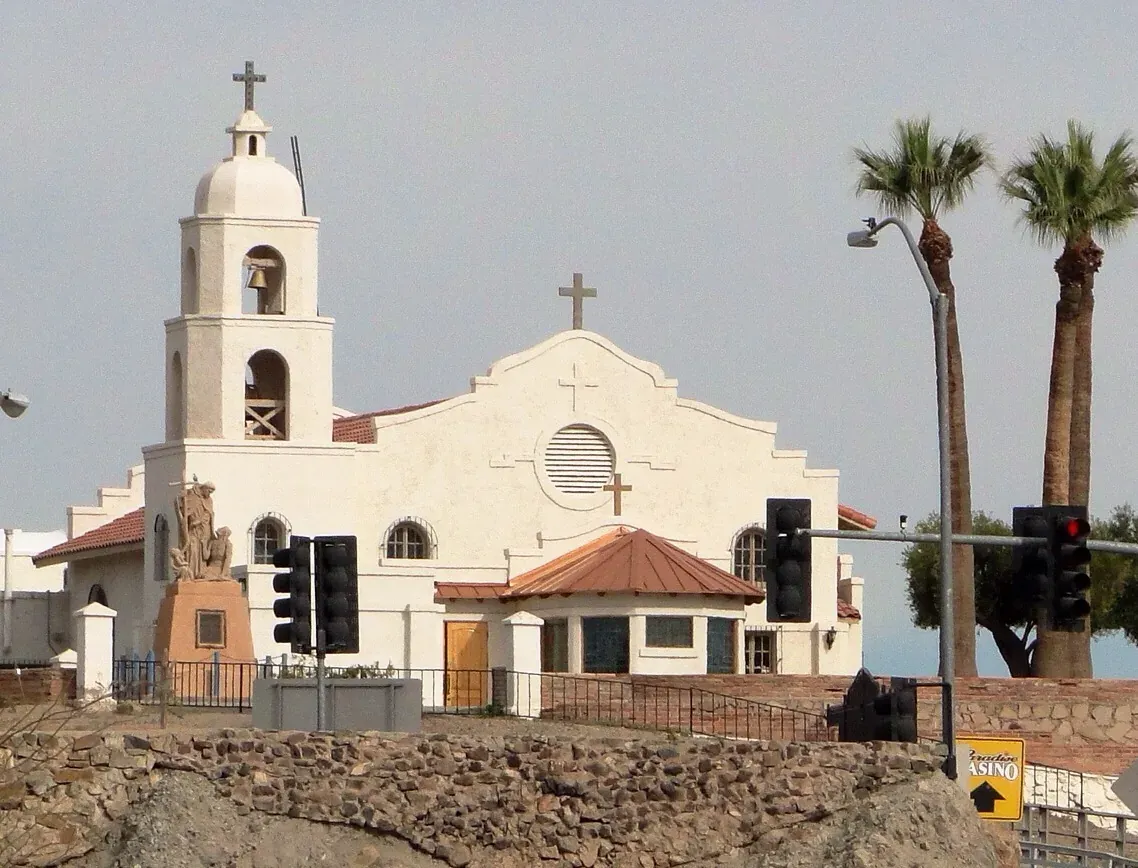
The St. Thomas Indian Mission stands on Indian Hill, the site of the 1780 Concepción settlement. Photo: Cbl62, via Wikimedia Commons, licensed CC BY-SA 3.0. Original photo, unmodified.

The Cocopah Tribe's history notes that the 1848 treaty ending the Mexican-American War “divided the U.S.-Mexican border and the Cocopah lands between the two countries.”
The Quechan Tribal Council put it this way in a letter on its website: “We have been here since time immemorial and our enduring presence in these landscapes predates political boundaries.”
Saturday, Nov. 28, is the 251st anniversary of the meal. Friday is Native American Heritage Day.
This week in Yuma: Thanksgiving week guide: recycling, closures and free meals | Thanksgiving weekend events, Nov. 27 to 29 | Quechan and Winterhaven bridges | Part 2: “Necessary to compel attendance”
Where this comes from
Diary quotes are from Herbert E. Bolton's 1931 English translation of Anza's diary.
- Anza diary, Nov. 27 to 30, 1775 (Bolton translation, 1931). Primary record. Palma's request (Nov. 27), the shelter, the meal and the watermelon estimate (Nov. 28), the ford, the Quechan objection to rafts and the soldiers' relief (Nov. 29), the crossing (Nov. 30).
- Pedro Font diary, Nov. 28, 1775, printed p. 31 (Teggart edition, University of California, 1913). Primary record. Shelter and river junction. Rights record.
- California Historical Landmark No. 350, Mission La Purísima Concepción (site of). Official state record. Founding in October 1780, the colonists' conduct, destruction July 17 to 19, 1781, St. Thomas Indian Mission on the site.
- California Historical Landmark No. 921, Bicuñer. Official state record. Founding Jan. 7, 1781, attack July 17, 1781, crossing closed.
- National Park Service, Juan Bautista de Anza trail historic resource study, printed pp. 83 to 84. Federal study. Font's account of Garcés carried across; Garcés and Eixarch stay behind. (The study dates the crossing Nov. 28; the diaries put it Nov. 30, and this story follows the diaries.)
- NPS biography of Francisco Garcés. Federal record. Garcés killed in the uprising; four Franciscans named.
- Nevada State Historic Preservation Office, Garcés expedition marker. Official state record. Garcés's death in July 1781.
- University of Arizona Special Collections, Garcés diary manuscript. Archive record. Garcés's 1775 travel with Anza.
- City of Yuma, “History of Yuma, AZ”. Official city page, undated. 1540 contact, “80 years before the Pilgrims.” (The page describes both 1540 expeditions as sailing; Díaz came overland.)
- Cocopah Indian Tribe, “About Us”. The tribe's own published history. Alarcón's crew and the gifts; the 1848 treaty.
- Fort Yuma Quechan Indian Tribe, national monument page. The tribe's own published letter, undated (about early 2024). “Since time immemorial” quote.
- Pilgrim Hall Museum, “The First Thanksgiving at Plymouth”. Museum. Autumn 1621, 53 surviving colonists, about 90 men with Massasoit.
- Massachusetts Trial Court Law Libraries, “Thanksgiving in Massachusetts history”. Official state page. The 1637 “subdewing the Pecoits” order.
- Founders Online, Washington diary, Nov. 26, 1789 and Mount Vernon, “Thanksgiving”. National Archives and museum. 1789 and 1863 dates.
- National Archives, “Pre-Federal Thanksgivings”. National Archives. Continental Congress thanksgiving, 1777.
- Library of Congress. 1941 fourth-Thursday law.
- Native American Heritage Day Act of 2009, Public Law 111-33. Federal law. Friday after Thanksgiving.