Guide
The oddest things to do in Yuma, ranked by how hard they are to explain to your relatives
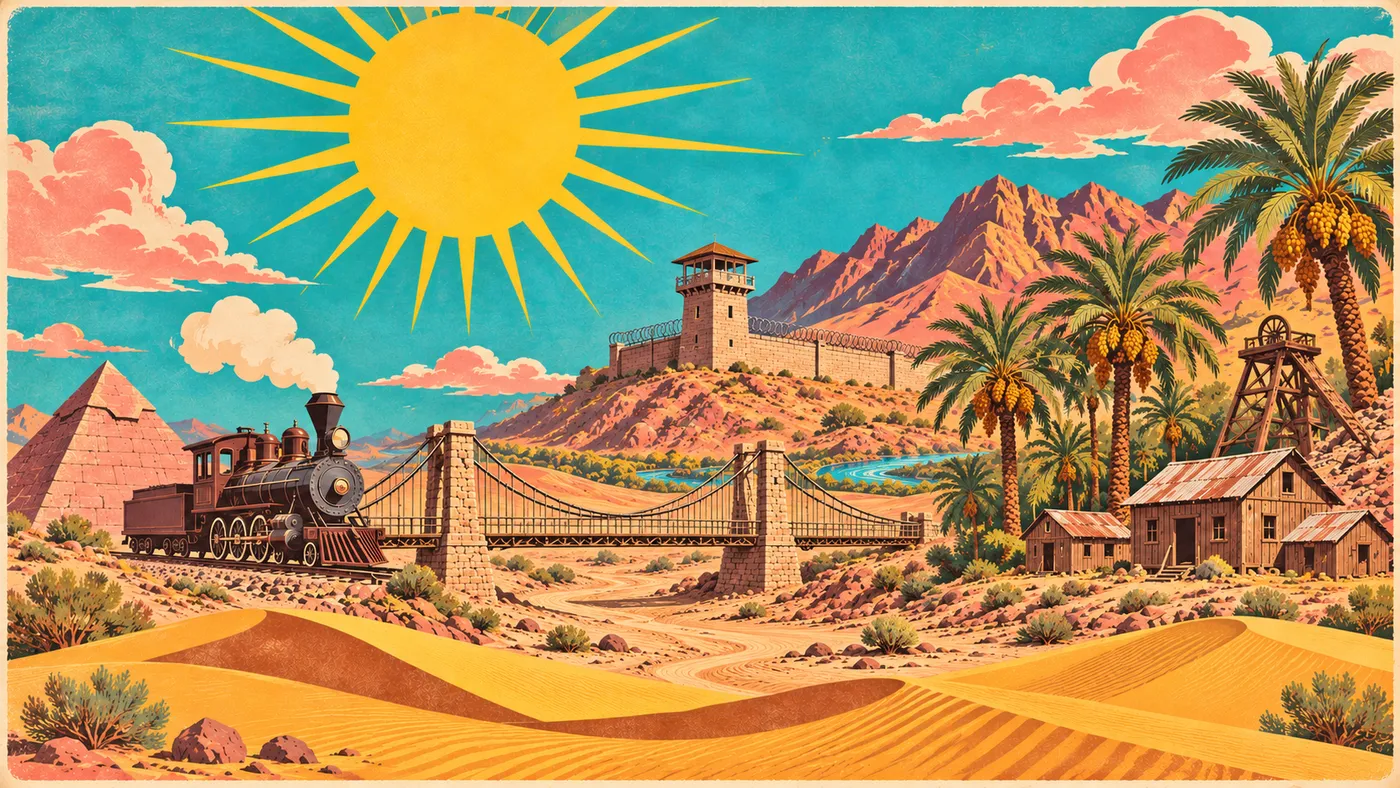
A hot dog on a cheeseburger. A high school that held class in a prison. A bridge to nowhere. The official Center of the World, in California, on Arizona time. Winter is when Yuma's strange stuff opens back up.
Founder & Publisher
- Published
Full article
Yuma has a funny relationship with normal.
It's a farm town that feeds much of the country salad all winter. It's a military town where jets are part of the soundtrack. Guinness World Records lists it as the sunniest city on Earth. And if you know where to look, it's also home to some of the strangest afternoons you can have in the Southwest.
Now's the time. A lot of what's on this list keeps winter hours, because nobody wants to explore a ghost town in July. A few stops are just over the line in California, and a couple are a real drive. I've flagged those.
Here's the list, roughly in order of how hard each one is to explain to your relatives back home.
1. Eat a hot dog on a cheeseburger
Lutes Casino, at 221 S. Main St., isn't a casino. It hasn't been one for a long time.
The building went up in 1901 as a general store with a hotel upstairs, according to an Arizona Highways history. In 1920 it became a billiard parlor. Today Lutes calls itself the oldest pool hall in Arizona, and the dominoes players are still part of the furniture.
The thing to order is the Especial: a cheeseburger with a hot dog on it, plus the house's special sauce. It sounds like a dare. Locals order it like it's a sandwich, because to them it is.
If that's too much, Visit Yuma announced last year that Lutes' potato tacos made a list of Arizona's top 100 dishes.
2. Go to the prison where the high school went to class
The Yuma Territorial Prison opened in 1876, which makes 2026 its 150th year. The park manager told KYMA that 3,069 men and women were locked up there. Its reputation as a hellhole was earned with heat and crowding. You can still look into the Dark Cell, the cave-like room used for solitary punishment.
Here's the odd part.
After the last prisoners were moved out in 1909, Yuma's brand-new high school needed space. According to the prison museum, Yuma High held classes in the cellblock for about three years starting in 1910, with assemblies in the old prison hospital.
Then Yuma's football team went to Phoenix and beat Phoenix Union. The angry home crowd called the Yuma players "Criminals." It was meant as an insult. The school board made it the official nickname in 1917, the museum says, and Yuma High has been the Criminals ever since.
Admission is $10 for adults, $7 for kids 7 to 13, and free for 6 and under. Winter hours are 9 a.m. to 4:30 p.m. daily, according to the park.
3. Stand at the official Center of the World
Drive west on Interstate 8, across the river into California, and take exit 164. There's a pink granite pyramid.
This is Felicity, a town founded in 1986 by Jacques-André Istel and named for his wife, Felicia. Inside the 21-foot pyramid is a plaque marking what Imperial County recognized as the official Center of the World. Travel writers report that France's national geographic institute signed off too. To be clear, this is a ceremonial center, not a scientific one.
Is it the center of the world? It's the center of this one, and it has the paperwork.
The grounds also hold a church on a hill and long granite walls engraved with history. From Nov. 1 through April 30, the museum is staffed from 10 a.m. to 5 p.m. daily, admission is $10 for adults and $5 for kids 5 to 12, and a visit to the Center of the World is included, according to the museum's site. Guided tours, and a certificate for standing on the spot, start at Thanksgiving.
One more odd detail, straight from the museum: it runs on Mountain Standard Time, not Pacific. A California town on Arizona time.
4. Look at a bridge to nowhere
About 15 miles east of Yuma, at Dome, a suspension bridge stands over dry desert.
The McPhaul Bridge was finished in December 1929 and carried U.S. 95 over the Gila River, according to the Arizona Department of Transportation. Its design help came from Ralph Modjeski, a well-known suspension bridge engineer. It's named for Henry Harrison McPhaul, a Yuman who served with the Arizona Rangers.
In 1968 it was judged too light for modern traffic. A new highway bridge went in, the river was rerouted, and the old bridge was left standing over nothing. People online started calling it the Bridge to Nowhere, and it stuck.
ADOT says it's in reasonably good shape for its age, but nobody, on foot or in a car, is allowed to cross it anymore. Look from the ground. Don't climb on it.
5. Walk through a ghost town with a glowing mine
Castle Dome dates to 1863, a mining camp in the mountains north of Yuma with more than 300 mines in its district. The museum that now owns it says it was bigger than Yuma in the 1870s. Mining hung on, off and on, until 1979.
Allen and Stephanie Armstrong bought the site in 1994 and turned it into the Castle Dome Mines Museum, with dozens of restored buildings full of what the miners left behind. Then, in 2016, a friend of the museum found a wall of fluorescent minerals inside the Hull Mine. Under blacklight, it glows.
Per the museum's site: the 1.8-mile walking tour of the town is $20 cash, $7 for kids 7 to 11, and free for 6 and under. The guided underground Hull Mine tour, which includes the town, is $75 cash, with kids 7 to 11 at $35 cash. Visit Yuma says to reserve a mine tour spot.
The museum is open daily 10 a.m. to 5 p.m. from Oct. 15 to April 15, except Thanksgiving and Christmas.
Getting there is part of it. Take U.S. 95 to mile marker 55 and turn onto Castle Dome Mine Road. The first 3 miles are paved. After that it's dirt, through Yuma Proving Ground land and the Kofa National Wildlife Refuge, to a dead end at the museum, about 10 miles in.
6. Count the Model Ts in somebody's backyard
Just over the river in Bard, California, about 10 miles north of Yuma, Johnny Cloud has been collecting since 1989.
The Cloud Museum, at 1398 York Rd., is old cars, trucks and tractors, plus tools, household gear, boat engines and pieces of the old Bard Post Office. The museum's site says it holds 125 Ford Model As and Model Ts. Visit Yuma says more than 90 of them are Model Ts.
It's $10, open daily 9 a.m. to 4 p.m., except during the hottest summer months, according to the museum's site. Cloud or a caretaker is usually on hand.
7. Walk up to a tank without getting on base
Yuma Proving Ground spends its days testing military hardware in the desert. You can't just drive in. But you don't have to.
Right outside the gate, in front of the Visitor Control Center, the Wahner Brooks Interpretive Display, known as the Open Air Museum, puts large historic military equipment where anyone can walk up to it. The Army says it's open to the public and needs no special access.
The Heritage Center museum is inside the gate, and that one does require base access. Stay on the public side of the gate unless you're cleared to go in.
8. Visit the place where a movie exploded a giant sand barge
In April 1982, a film crew set up in Buttercup Valley in the Imperial Sand Dunes, just west of Yuma on the California side. They were working under a fake title, "Blue Harvest," to keep fans away.
It was actually "Return of the Jedi." The desert-pit and sail barge scenes were shot there, and the crew stayed in Yuma, according to the American Film Institute catalog and later Yuma Sun retellings. AFI cites a trade report that the production put about $4 million into the Yuma economy.
There's nothing left out there but sand. That's sort of the point. You're standing on a famous movie planet, and it looks exactly like the dunes.
The dunes are a Bureau of Land Management recreation area. If you're driving in, check the BLM's Imperial Sand Dunes page for the season's permit rules first.
9. Drink a date shake in a town called Dateland
About an hour east on I-8 is Dateland. It's named for exactly what you think.
The Dateland Travel Center has been selling date shakes for generations. Its own website admits it isn't completely sure where the date shake came from, but says some stories trace it to the original Dateland restaurant, built in the late 1920s.
The shake is thick, sweet and a little chunky with date pieces. The travel center also has a date bakery, homemade date ice cream, a Pizza Hut and outdoor kennels you can rent for your dog while you shop. It says it's always open.
10. Listen for a ghost train
At the end of Madison Avenue, by the river, sits a 1907 Baldwin steam locomotive. It's parked at Pivot Point Interpretive Plaza, on the spot where the first train rolled into Arizona in 1877.
The plaza is named for something easy to miss: the concrete pivot of the old railroad bridge. The bridge swung open like a gate so steamboats could pass on the Colorado River, back when the Colorado was a river you could run a steamboat on.
When the plaza opened in 2009, Yuma Crossing National Heritage Area built in a sound system that recreates a steam train arriving, which it called the "ghost train," and a laser display tracing where the tracks crossed the river. I can't promise both are running on the night you go. The locomotive and the pivot don't need electricity, and the plaza is free.
The honest disclaimer
Hours change, and some of these are small operations in remote spots. Check the website before you drive anywhere with dirt on the last 7 miles.
And if you've got a stranger one, I'd like to hear it.
Where this comes from
- Arizona Highways: The Casino that Lutes Built (building history)
- Fodor's: Lutes Casino (oldest pool hall claim, Especial)
- Visit Yuma, Jan. 2, 2025: Lutes Casino's potato tacos named among Arizona's top 100 dishes
- ABC15: Yuma Territorial Prison marks 150 years (1876 opening, dark cell)
- KYMA: Come visit Yuma's Territorial Prison after dark (3,069 inmates)
- Yuma Territorial Prison museum: Yuma High School history and admission and hours
- Yuma Union High School District: Our history
- Museum of History in Granite: Admission and tours (hours, MST, admission, tour and certificate season, exit 164)
- Culture Trip: Everything you need to know about Felicity (1986 founding, 21-foot pyramid, Imperial County and French recognition)
- Arizona Department of Transportation, July 7, 2020: Yuma's Bridge to Nowhere
- Castle Dome Mines Museum: castledomemuseum.org (hours, prices, directions), Hull Mine (2016 discovery); Showcaves.com: Castle Dome Mine Museum (1979, 1994)
- Visit Yuma: Castle Dome (reserve mine tours)
- Cloud Museum: cloudmuseum.dynamitedave.com; Visit Yuma: Museums (Model T count)
- U.S. Army, July 30, 2021: Heritage Center at Yuma Proving Ground among top places to visit in Yuma
- AFI Catalog: Return of the Jedi (1983) (Buttercup Valley, $4 million figure)
- Movie-Locations.com: Return of the Jedi ("Blue Harvest" cover title)
- Dateland: World Famous Date Shakes and Travel Center
- Yuma Visitors Bureau release: New riverfront plaza opens window into history of Yuma Crossing (locomotive, pivot, ghost train, lasers)
Sources 23
- Primary source · Public statementadmission and hours
Yuma Territorial Prison museum: Yuma High School history and admission and hours
- Primary source · Public statementAdmission and tours
Museum of History in Granite: Admission and tours (hours, MST, admission, tour and certificate season, exit 164)
- Primary source · Public statementCastle Dome
Visit Yuma: Castle Dome (reserve mine tours)
- Secondary source / research lead · News reportCastle Dome Mine Museum
Castle Dome Mine Museum historical timeline, including the 1979 mining closure and Armstrong purchase in 1994. Its 2017 discovery date differs from the museum's 2016 date; the guide follows the museum.
- Primary source · Public statementCastle Dome Mines Museum: Hull Mine information
The museum dates discovery of the fluorescent geological feature to 2016 and lists a $75 tour including museum entrance, with $35 cash for children ages 7 through 11.
- Primary source · Public statementcastledomemuseum.org
Castle Dome Mines Museum official website: admission, hours and directions. The museum dates discovery of the fluorescent feature to 2016 on its separate Hull Mine information page.
View 17 more sources
- Primary source · Public statementcloudmuseum.dynamitedave.com
Cloud Museum: cloudmuseum.dynamitedave.com; Visit Yuma: Museums (Model T count)
- Secondary source / research lead · News reportCome visit Yuma's Territorial Prison after dark
KYMA: Come visit Yuma's Territorial Prison after dark (3,069 inmates)
- Secondary source / research lead · News reportEverything you need to know about Felicity
Culture Trip: Everything you need to know about Felicity (1986 founding, 21-foot pyramid, Imperial County and French recognition)
- Primary source · Public statementHeritage Center at Yuma Proving Ground among top places to visit in Yuma
U.S. Army, July 30, 2021: Heritage Center at Yuma Proving Ground among top places to visit in Yuma
- Secondary source / research lead · News reportLutes Casino
Fodor's: Lutes Casino (oldest pool hall claim, Especial)
- Primary source · Public statementLutes Casino's potato tacos named among Arizona's top 100 dishes
Visit Yuma, Jan. 2, 2025: Lutes Casino's potato tacos named among Arizona's top 100 dishes
- Primary source · Public statementMuseums
Cloud Museum: cloudmuseum.dynamitedave.com; Visit Yuma: Museums (Model T count)
- Primary source · Public statementNew riverfront plaza opens window into history of Yuma Crossing
Yuma Visitors Bureau release: New riverfront plaza opens window into history of Yuma Crossing (locomotive, pivot, ghost train, lasers)
- Primary source · Public statementOur history
Yuma Union High School District: Our history
- Secondary source / research lead · News reportReturn of the Jedi
Movie-Locations.com: Return of the Jedi ("Blue Harvest" cover title)
- Primary source · OtherReturn of the Jedi (1983)
AFI Catalog: Return of the Jedi (1983) (Buttercup Valley, $4 million figure)
- Secondary source / research lead · News reportThe Casino that Lutes Built
Arizona Highways: The Casino that Lutes Built (building history)
- Primary source · Public statementTravel Center
Dateland: World Famous Date Shakes and Travel Center
- Primary source · Public statementWorld Famous Date Shakes
Dateland: World Famous Date Shakes and Travel Center
- Primary source · Public statementYuma High School history
Yuma Territorial Prison museum: Yuma High School history and admission and hours
- Secondary source / research lead · News reportYuma Territorial Prison marks 150 years
ABC15: Yuma Territorial Prison marks 150 years (1876 opening, dark cell)
- Primary source · Public statementYuma's Bridge to Nowhere
Arizona Department of Transportation, July 7, 2020: Yuma's Bridge to Nowhere