Analysis
CBP counted 10,622 border-barrier submissions but did not name Tribal governments contacted
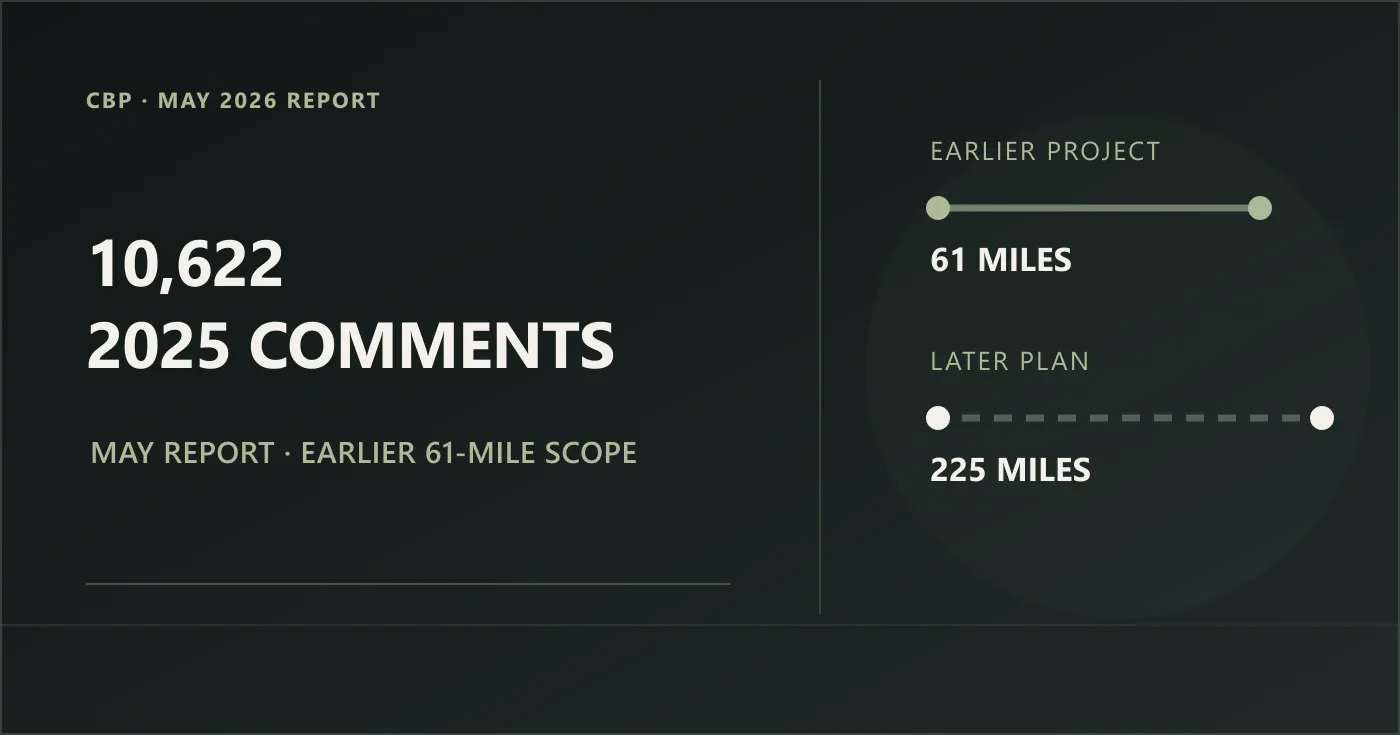
CBP’s May report counted 10,622 comments from a 2025 round on an earlier 61-mile barrier project. A later letter used that feedback as background for outreach on a separate proposed 225-mile system.
Founder & Publisher
- Published
Full article
U.S. Customs and Border Protection says it met with Tribal leaders while planning border barriers in Arizona. Its published summary does not identify the Tribal governments contacted, who attended the meetings or whether any particular concern changed a construction decision.
The distinction matters in Yuma County, where a newer proposal includes about 23 miles of secondary barrier. CBP's May 27, 2026 Stakeholder Feedback Report counts 10,622 submissions during a Nov. 20 to Dec. 22, 2025 public-comment period and describes steps the agency says it is taking to limit environmental and cultural harm. It does not connect individual comments to decisions.
Those 10,622 submissions concern an earlier plan covering approximately 61 combined miles of primary and secondary barriers. They are not a tally for the additional outreach that closed Oct. 12, 2026, on roughly 225 miles of secondary barrier across four Arizona counties. CBP's Sept. 11 update letter refers readers back to the May report, but it does not show what the later comment period produced.
What the 10,622 submissions tell us
CBP counted 10,581 responses submitted through a nongovernmental organization's form and 41 individual responses. It characterizes the form submissions as opposition to border infrastructure in southern Arizona. The total is a count of submissions, not a verified count of individual people. Comments could also be assigned to more than one issue category.
The report says the agency sent 19 emails and 49 letters to stakeholders and posted information on its website. It describes meetings with federal land managers, Tribal leaders and landowners. But the published summary provides no recipient list, meeting dates, names of participants or meeting minutes. It is therefore impossible to determine from this report how many Tribal governments received direct notice or which governments took part in a meeting.
A separate Dec. 22 coalition submission identifies the San Xavier District of the Tohono O'odham Nation among those on whose behalf the Center for Biological Diversity says it submitted comments. The coalition urged protection of cultural landscapes and wildlife corridors and meaningful Tribal participation. That filing documents a named public-comment contributor. It does not establish that CBP contacted the district directly or held formal government-to-government consultation with it.
Concerns appear in the report. Their individual outcomes do not.
CBP grouped 32 commenters under wildlife and environmental concerns, including habitat fragmentation, vegetation loss and water use. The reported concerns include pressure on aquifers, changes to drainage and lighting that could disturb wildlife and dark skies.
Thirteen commenters raised cultural and community concerns. Three described inadequate Tribal consultation and possible harm to sacred sites, burial grounds or traditional cultural properties. These are concerns recorded by the agency, not agency findings that a specific site was damaged or that a government was excluded. Other objections concerned legal waivers, project costs and the barrier's effectiveness.
CBP describes more than a general promise to consider the comments. It says cultural surveys were completed before construction, contractors receive training about sensitive resources, and natural and cultural monitors oversee construction practices. The report also discusses small wildlife passages, drainage gates, water-use monitoring, and coordination over wells and staging areas. CBP commits not to draw surface water from the Santa Cruz River, a specific restriction that does not answer which water supplies contractors might use in Yuma County.
The agency says it continues to coordinate with Tribal nations and welcomes their participation in construction monitoring. Those are descriptions of its own actions and commitments. The report does not include site-level monitoring records or show how a particular comment altered a design.
CBP acknowledges that its summary does not reproduce individual comments or individual responses, although it says unique comments were answered as appropriate. Without that correspondence, readers cannot trace a concern to an agency answer, a design change or a decision to leave plans unchanged.
Where the Yuma County work stands
The September letter assigns approximately 23 miles of secondary barrier to Yuma County. CBP's construction map, checked Oct. 14, shows a 22.5-mile project called Tucson 1 in Yuma County and the Wellton Border Patrol area, marked Under Construction and assigned to the Yuma sector.
The location and mileage appear consistent with the letter's rounded Yuma County figure, but the letter gives no project identifier proving they are the same work. Nor does the map establish how many miles have been completed.
No public tally or response report for the October comment period was identified among the materials reviewed through Oct. 14. With only two days elapsed since the deadline, that gap does not establish whether comments were received or whether CBP intends to issue a report.
CBP describes its public-input process as consultation under Section 102 of the Illegal Immigration Reform and Immigrant Responsibility Act. Public comments, general outreach and formal government-to-government Tribal consultation are not interchangeable records. The absence of meeting and consultation logs prevents a meaningful review of who was contacted and what happened; it does not, by itself, prove a Tribe was excluded.
The unanswered questions have identifiable sources: notification lists, correspondence, meeting records, the later comment tally and documents showing whether feedback affected plans. CBP says the comments and surveys will inform an Environmental Summary Report when that work is complete. The materials reviewed provide neither a publication date nor a county-by-county account of how the decisions were made.
Sources 3
- Primary source · Government recordCBP May 2026: Arizona border-barrier stakeholder feedback report
Six pages. Summarizes November-December 2025 input on earlier 61-mile primary/secondary scope, not comments on full expanded 225-mile proposal. Environmental, cultural, community and economic concerns are attributed comments, not adjudicated findings. Pages 5-6 state surveys, monitors, BMPs, tribal/land-manager coordination, wildlife passages and water mitigation. Next Steps says feedback/surveys inform planning and execution; ESR to be released through CBP.gov on completion. No county-specific completion or report publication date.
- Primary source · Government recordCBP September 11, 2026: Arizona secondary-barrier update and request for additional input
Signed two-page letter. County allocation: Cochise 81, Pima 62, Santa Cruz 59, Yuma 23 miles. Deadline October 12, 2026; no closing hour or time zone. Subject Tucson Sector Secondary Barrier Construction. Names and addresses become public record. This letter and current CBP webpage govern article submission instructions where StoryMap wording differs.
- Primary source · Government recordCBP Smart Wall map: Tucson 1 secondary barrier in Yuma County and construction status
Read October 12, 2026; webpage last modified October 7. Active embedded experience c5d05c7ba737452f85f7b9ee4b2ea99a uses webmap 55a180e86712497fb34974e3f9b54447. Projects service Experience_Builder_Map_v2_WFL1/FeatureServer/1, OBJECTID 979: TCA-1 Secondary Wall Project, Tucson 1 Project, County Yuma County, Wellton AOR, Secondary Border Wall, Length_Miles 22.5, Status_1 Under Construction. Generalized endpoints near county line 32.0395,-113.3341 west to 32.1513,-113.6908. Service last edit September 29, 2026. CBP defines Under Construction as active wall-panel or waterborne-barrier construction/deployment. Does not establish completed mileage, specific start date or independent field observation. Keep YUM-1 technology, YUM-2 walls/waterborne work and TCA-1 system attributes distinct. Identifying this as September letter rounded 23-mile section is a reasoned cross-source match, not an explicit ID crosswalk in that letter.
Related topics 1
- Arizona border barriers and tribal consultation
Reporting on proposed border-barrier construction in Yuma County, public input, and documented consultation with Tribal governments.