Explainer
Can Yuma Create Its Own Conflict-of-Interest Rules? What Arizona Law Actually Says
A public Yuma Transparency Club discussion guide now outlines an elected ethics commission, complaint powers, proposed fines and funding. Yuma can create an ethics body, but several provisions need separate review under the City Charter and Arizona conflict law.
Founder & Publisher
- Published
Full article
Yuma can create an ethics commission. It can also regulate some local conduct, including ethics in public contracting. But Arizona law sets a strong limit on replacing the state’s financial conflict-of-interest rules with a city version. What a particular commission could do depends on the powers written into its proposal.
What state law requires
Arizona’s conflict-of-interest law applies to city officers and employees. It defines which financial interests count, when an official must disclose an interest and stay out of a decision, and the penalties for violations. The key provision, A.R.S. § 38-501(B), says the state article is “exclusively applicable” and supersedes contrary local charters and ordinances.
For example, § 38-502 distinguishes a “substantial interest” from interests the statute calls “remote.” § 38-503 requires disclosure and nonparticipation when an officer or employee, or a covered relative, has a substantial interest in the agency’s contract, transaction or decision. § 38-510 supplies criminal penalties for specified violations. The Attorney General’s handbook explains the law and reads the article as superseding local conflict rules; it is guidance, not a court ruling.
What Yuma can establish
Yuma’s Charter gives the City Council direct authority to create boards and commissions. Article IX, § 1 permits Council to create them by ordinance or resolution and assign duties consistent with the Charter. Article VI, § 15 separately lets Council set their appointment, terms, duties and removal. The Charter also requires Council appointment, city residency, terms of no more than five years and annual review of boards. These provisions support creating an ethics body; they do not authorize every possible enforcement power.
The Charter also addresses the substance of conflicts. Article VI, § 17 says that when a possible conflict of interest exists, A.R.S. § 38-503 or other existing state conflict law governs. That is another reason a city ordinance cannot simply substitute its own financial-conflict standard.
Yuma already has local ethics rules
The city’s public-contracting rules use Arizona’s conflict law as the general standard for employees. Separate sections restrict gratuities and kickbacks, certain contractor-related employment, contingent fees and misuse of confidential information. The chapter also provides administrative and civil remedies. These existing rules show how local conduct standards can operate alongside state conflict law. They do not settle whether every new rule would survive a legal challenge.
What an ethics commission could do
Ethics education, receiving complaints, voluntary fact-finding, guidance on valid local rules, recommendations and referrals appear to be within ordinary municipal authority, subject to the details of the ordinance and applicable procedures. Phoenix’s Ethics Commission provides one working example, but Phoenix limits its own authority to what the law permits. Scottsdale and Tempe also have local ethics or disclosure systems. Their practices are examples, not court approval of any Yuma proposal.
Stronger powers require a closer look. Yuma’s Merit System Board can issue subpoenas in employee-discipline appeals because a specific city ordinance grants that power. A new ethics commission would not inherit it. Compelling evidence, deciding state-law violations, imposing fines or removing elected officials would each require separate legal authority and safeguards. The legality of those powers cannot be inferred from the power to create a board.
Where the boundary remains unsettled
A local rule that redefines a state financial conflict, changes when a substantial interest requires recusal, or substitutes a different penalty is likely to face a serious challenge under § 38-501(B). A separate rule about gifts, procurement fairness or additional information disclosure may stand on firmer ground. This is a legal inference from the statutory text, Yuma’s Charter and existing practice, not a ruling on a particular Yuma measure.
Arizona’s Supreme Court has addressed home-rule disputes over Phoenix elections in Strode, magistrate removal in Jett, firearm disposal in a 2017 Tucson case and election timing in a 2021 Tucson case. Those decisions help explain how courts compare city and state authority. None decides the validity of a competing municipal Title 38 code. The cases reviewed for this story did not supply a directly on-point Arizona appellate ruling on that question.
A written discussion proposal is now public
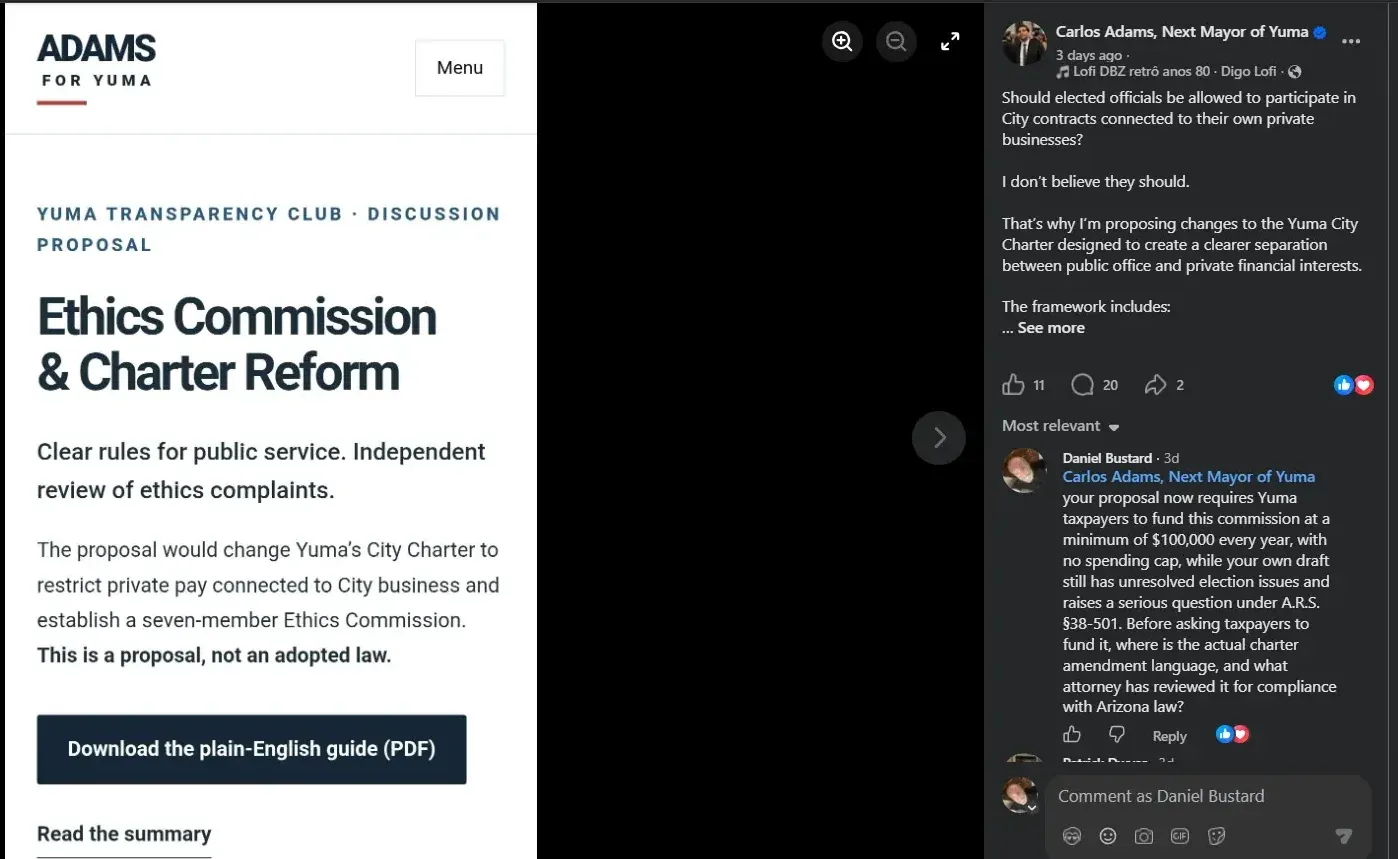
The Adams for Yuma ethics-reform page presents a Yuma Transparency Club “Discussion Proposal” and links to its September 2026 plain-English guide. The page directs questions and feedback to Carlos. The document identifies the Yuma Transparency Club, so it should not be described as a set of provisions personally authored by Carlos Adams. It is a proposal, not an adopted city rule.
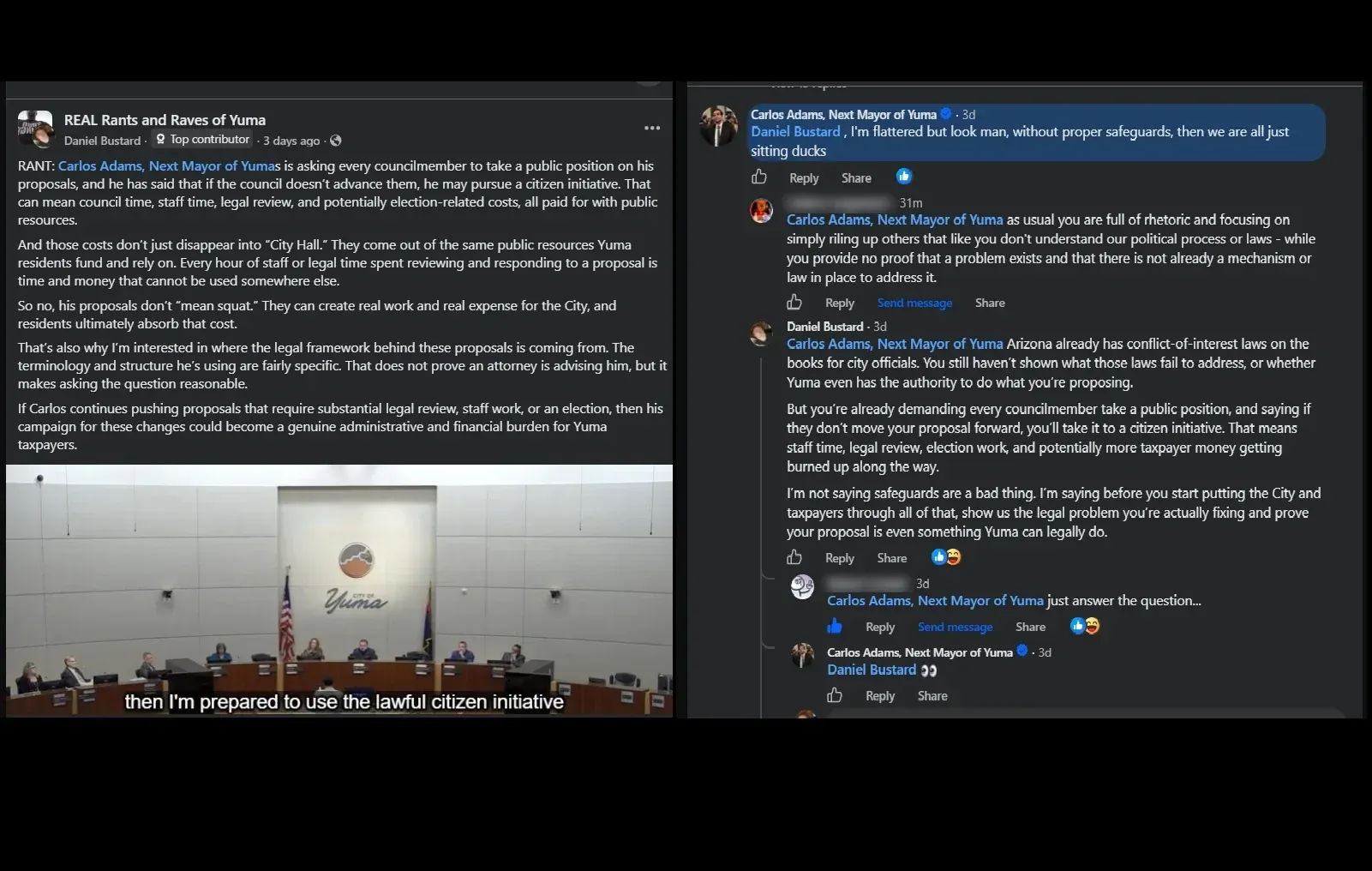
In a captured Facebook exchange, Yuma Informed asked what existing Arizona conflict-of-interest law fails to address and whether Yuma had legal authority to enact the proposed changes. Adams initially replied about the need for safeguards. After the authority question was repeated, he replied with an eyes emoji. The specific legal-authority questions were not answered in the portion of the exchange shown. That observation does not establish his motive or rule out a response elsewhere.
Yuma Informed later asked Adams where the full Charter-amendment or initiative language underlying the published discussion materials could be reviewed and what attorney had reviewed it for compliance with Arizona law. In a subsequent email, Yuma Informed asked Adams directly for the full current draft and whether any version had been formally filed or submitted to the City. Adams replied that it was “in the works as we speak” and that “The YTC is collectively collaborating.” He did not provide a draft or answer whether any version had been formally filed or submitted.
What the proposal would restrict
The guide would bar the mayor and council from taking private pay for services connected to City contracts, projects, grants, property deals or other City business. It says disclosure, stepping out of a vote or competitive bidding would not excuse a prohibited payment. Covered employees would face similar limits on matters they handle or oversee. For two years after City service, covered officials and employees could not take paid work for others on particular City matters they handled, oversaw or learned important confidential information about; unrelated work would remain allowed.
Existing state law already restricts additional pay in matters before an official’s agency and some post-service representation and confidential-information use. Yuma also has separate procurement ethics rules. Whether the proposal’s broader payment and two-year work restrictions regulate distinct local conduct or compete with the state’s exclusive conflict rules depends on their final wording and operation. The guide alone does not settle that boundary.
Who would serve, and who would choose them?
The guide calls for seven Yuma residents eligible to vote in City elections. Four would have relevant experience, such as law, accounting or investigations; three would not need a special credential. Petition organizers named in the filing would appoint seven temporary members within 30 days after the amendment legally takes effect. City voters would elect all seven beginning in 2028, with two-year terms and a limit of two consecutive full terms. The mayor and council would not select or approve members.
Yuma’s current Charter authorizes boards and commissions but says Council appoints and removes their members. The proposed organizer appointments and elections therefore would require a valid change to that local framework; an ordinary ordinance could not simply ignore it. A charter amendment could change a city rule if properly adopted, but it would still have to comply with superior law. The guide itself says its staggered-term plan needs to be reconciled with the election schedule. The operative filing and election details remain to be examined.
Complaints, penalties and limits
The commission would review signed complaints, investigate matters within its authority and hire independent lawyers and investigators. The guide calls for notice, access to evidence as law permits, a fair hearing, public final findings and court review as allowed by law. Complaint intake, voluntary investigation, recommendations and referrals fit more comfortably within a city’s general commission authority. Any compulsory investigative or binding adjudicative power would need a specific legal basis and safeguards; the guide does not supply a complete legal mechanism.
After notice and a hearing, the guide proposes a civil fine of up to $5,000 per knowing violation or three times the unlawful financial benefit, whichever is higher, if legally authorized. It also proposes lawful repayment, public reprimand, employee-discipline recommendations and referrals. The commission could not itself remove the mayor or a council member. Arizona law separately supplies penalties and court remedies for Title 38 violations. A local fine or repayment order that substitutes for those rules raises a substantial authority and preemption question. Whether a remedy for a distinct, valid local ethics rule could stand is unresolved on this record.
Funding and what remains unknown
The guide calls for at least $100,000 in City funding each year, with an inflation adjustment starting in the second full fiscal year and no drop below $100,000. That is a proposed minimum, not a cost estimate or spending cap. Each commissioner would receive $300 for a month in which they attend at least one properly noticed meeting, plus lawful, documented expenses. It also calls for an annual report and public accounting. The City’s lawful budget process and any authority for these payment commitments need separate review; permission to hire staff or counsel does not show what the City would actually spend.
The published three-page guide is not the complete operative Charter-amendment text. Adams told Yuma Informed on September 23 that the fuller proposal was “in the works” and that the Yuma Transparency Club was collectively collaborating on it. A completed draft, any formal filing or revisions, and City legal and fiscal analyses therefore remain unavailable for a final clause-by-clause assessment. On the record now available, Yuma can create an ethics body and regulate some local conduct. Arizona law poses a strong barrier to replacing its substantive financial-conflict system. The proposed selection rules, restrictions, fines, remedies and funding each require their own legal review; none can responsibly be labeled categorically legal or illegal from this guide alone.
Why this matters to Yuma
City rules affect how Yuma officials disclose interests, participate in decisions, and remain accountable to residents.
Related claims 11
- Mostly SupportedA local rule that materially changes Arizona’s financial-conflict definitions, mandatory recusal requirements, or statutory penalties would face significant preemption concerns.
Section 38-501(B) has express exclusivity language within a home-rule system subject to state law.
- VerifiedA.R.S. § 38-501(B) states that Article 8 is exclusively applicable and supersedes contrary local charter provisions and ordinances.
The statute expressly uses exclusive and supersession language.
- VerifiedArizona’s conflict-of-interest statutes apply to municipal officers and employees.
A.R.S. § 38-501(A) expressly includes incorporated cities and towns.
- Mostly SupportedMunicipal ethics regulation outside the substantive financial-conflict field may coexist with Arizona Title 38, depending on its design and operation.
Municipalities use conduct rules, gifts, training, disclosure, and oversight while recognizing Title 38.
- VerifiedStrode, Jett, and the cited Brnovich decisions address other home-rule disputes; none decides whether Yuma may enforce a competing Title 38 financial-conflict code.
The cited decisions concern elections, magistrate removal, and firearm disposition, not a Yuma ethics code.
- VerifiedThe September 2026 Yuma Transparency Club discussion guide proposes a seven-member Ethics Commission, with temporary members initially appointed by petition organizers and all seven elected by Yuma voters beginning in 2028.
The guide states who would serve and how members would initially be selected and later elected.
View 5 more related claims
- VerifiedThe Yuma Transparency Club guide proposes a civil fine of up to $5,000 per knowing violation or three times the unlawful financial benefit, whichever is higher, only if such a fine is legally authorized.
The proposed civil fine is expressly conditional on legal authorization.
- VerifiedYuma maintains local procurement rules addressing gratuities, kickbacks, employment restrictions, contingent fees, confidential information, and remedies.
Chapter 36 contains procurement ethics standards; § 36-70 refers to A.R.S. §§ 38-501 et seq.
- Mostly SupportedYuma may establish an Ethics Commission as a municipal board or commission under its Charter, but each assigned power must comply with the Charter and state law.
The Charter expressly authorizes new boards and commissions; particular powers require separate legal review.
- VerifiedYuma’s Charter authorizes the City Council to create boards and commissions.
Charter Articles IX, § 1 and VI, § 15 expressly authorize Council to create boards and commissions.
- VerifiedYuma’s Charter directs conflicts of interest involving City officials to Arizona state conflict-of-interest law.
The Charter conflict provision is identified in the research as referring to state law.
Sources 36
- Primary source · Government recordA.R.S. § 38-501 — Application of Conflict-of-Interest Laws
Official Arizona Revised Statutes Article 8 text, section 501.
- Primary source · Government recordA.R.S. § 38-502: Definitions
Official Arizona Revised Statutes Article 8 text, section 502.
- Primary source · Government recordA.R.S. § 38-503: Conflict of Interest; Exemptions; Employment Prohibition
Official Arizona Revised Statutes Article 8 text, section 503.
- Primary source · Government recordA.R.S. § 38-504: Prohibited Acts
Official Arizona Revised Statutes Article 8 text, section 504.
- Primary source · Government recordA.R.S. § 38-505: Additional Income Prohibited for Services
Official Arizona Revised Statutes Article 8 text, section 505.
- Primary source · Government recordA.R.S. § 38-506: Remedies
Official Arizona Revised Statutes Article 8 text, section 506.
View 30 more sources
- Primary source · Government recordA.R.S. § 38-507: Opinions by Attorneys
Official Arizona Revised Statutes Article 8 text, section 507.
- Primary source · Government recordA.R.S. § 38-508: Authority to Act
Official Arizona Revised Statutes Article 8 text, section 508.
- Primary source · Government recordA.R.S. § 38-509: Filing of Disclosures
Official Arizona Revised Statutes Article 8 text, section 509.
- Primary source · Government recordA.R.S. § 38-510: Penalties
Official Arizona Revised Statutes Article 8 text, section 510.
- Primary source · Government recordA.R.S. § 38-511: Cancellation of Certain Contracts
Official Arizona Revised Statutes Article 8 text, section 511.
- Primary source · Government recordA.R.S. § 9-284: Effect of Charter on Inconsistent Laws
Charter law and limitations in subsection B.
- Primary source · Public statementAdams for Yuma: Ethics Commission & Charter Reform
Campaign website page publicly presenting the Yuma Transparency Club Ethics Commission and Charter reform discussion proposal. It links to a September 2026 plain-English PDF and directs feedback to Carlos.
- Secondary source / research lead · Government recordArizona Attorney General Agency Handbook, Chapter 8: Conflict of Interest
Arizona Attorney General Agency Handbook, Chapter 8, revised 2018 and currently posted by the AG. Persuasive explanatory guidance on conflict law, not binding judicial precedent.
- Primary source · Government recordArizona Constitution, Article XIII, Section 2
Home-rule charter authority is subject to the state Constitution and laws.
- Primary source · Public statementCaptured Facebook Exchange on Yuma Ethics Proposal Legal Authority
Composite screenshot retained as local Media ID 7 of a Facebook exchange in REAL Rants and Raves of Yuma. It shows Yuma Informed asking what existing Arizona conflict-of-interest law fails to address and whether Yuma has authority for proposed changes, followed by Adams’s safeguards response and an eyes-emoji reply after the authority question was repeated.
- Primary source · Government recordCity of Phoenix Ethics Commission and Ethics Policy Materials
Official description of ethics and gift policies, complaint, investigation, and recommendation processes; comparative only.
- Primary source · Public statementFacebook Comment Requesting Full Yuma Charter Amendment Language
Public comment by Daniel Bustard on Carlos Adams’s Facebook post about the ethics proposal, asking where the full Charter-amendment language can be reviewed and what attorney reviewed it for compliance with Arizona law.
- Primary source · Government recordJett v. City of Tucson, 180 Ariz. 115, 882 P.2d 426 (1994)
Arizona Supreme Court opinion on Tucson magistrate removal and parallel city/state authority. Original opinion text reproduced by Justia; it does not decide ethics-commission powers.
- Primary source · Government recordScottsdale Code of Ethical Behavior
Official ethics code, disclosure, and training materials; comparative only.
- Primary source · Government recordState ex rel. Brnovich v. City of Tucson, 242 Ariz. 588 (2017)
Arizona Supreme Court opinion holding state firearm-disposition law controlling over Tucson’s contrary ordinance. Original opinion text reproduced by Justia; it does not decide ethics-commission powers.
- Primary source · Government recordState ex rel. Brnovich v. City of Tucson, 251 Ariz. 45, 484 P.3d 701 (2021)
Official Arizona Supreme Court opinion on municipal election timing and home rule, not ethics commissions.
- Primary source · Government recordStrode v. Sullivan, 72 Ariz. 360, 236 P.2d 48 (1951)
Full text of the original 1951 Arizona Supreme Court opinion, reproduced by Justia. The case concerns Phoenix municipal elections and home rule, not ethics-commission powers; a court-hosted scan was not located.
- Primary source · Government recordTempe Conflict-of-Interest and Personal-Involvement Disclosures
Official page incorporates Title 38 in Council Rule 2 and posts separate Charter-based personal-involvement disclosures.
- Primary source · Government recordYuma City Charter, Article IX, Section 1: Boards and Commissions
Charter Article IX, § 1 expressly permits Council to create, change, or abolish boards and commissions by ordinance or resolution and assign Charter-consistent duties. It also sets appointment, term, residency, and annual-review rules.
- Primary source · Government recordYuma City Charter, Article VI, Section 15: Creation and Discontinuance of Offices, Boards and Commissions
Additional Charter authority for Council to create boards and commissions and prescribe appointment, terms, duties, and removal.
- Primary source · Government recordYuma City Charter, Article VI, Section 17: Conflict of Interest
Charter Article VI, § 17 says A.R.S. § 38-503 or other existing state conflict-of-interest law governs possible conflicts. Section amended by special election December 7, 1993.
- Primary source · Government recordYuma City Code § 34-02: Merit System Board
Yuma Merit System Board hears classified-employee discipline appeals and has expressly granted hearing, oath, witness, and subpoena powers. This is a municipal board example, not authority automatically transferable to an ethics commission.
- Primary source · Government recordYuma City Code § 36-70: Ethics in Public Contracting
Official online City Code text for § 36-70; printed City Code is definitive and later changes may exist.
- Primary source · Government recordYuma City Code § 36-71: Gratuities and Kickbacks
Official online City Code text for § 36-71; printed City Code is definitive and later changes may exist.
- Primary source · Government recordYuma City Code § 36-72: Restrictions on Employment of Present and Former Employees
Official online City Code text for § 36-72; printed City Code is definitive and later changes may exist.
- Primary source · Government recordYuma City Code § 36-73: Prohibition Against Contingent Fees
Official online City Code text for § 36-73; printed City Code is definitive and later changes may exist.
- Primary source · Government recordYuma City Code § 36-74: Use of Confidential Information
Official online City Code text for § 36-74; printed City Code is definitive and later changes may exist.
- Primary source · Government recordYuma City Code § 36-75: Public Access to Procurement Information
Official online City Code text for § 36-75; printed City Code is definitive and later changes may exist.
- Primary source · Government recordYuma City Code § 36-76: Civil and Administrative Remedies
Official online City Code text for § 36-76; printed City Code is definitive and later changes may exist.
- Primary source · Public statementYuma Transparency Club: Yuma Ethics Proposal, Plain-English Guide (September 2026)
Three-page September 2026 Yuma Transparency Club plain-English guide to a discussion draft for Yuma ethics and City Charter reform. It describes proposed conduct restrictions, commission structure, enforcement and funding; it is not the full operative charter-amendment text or adopted law.
Related topics 1
- Yuma Ethics, Conflict of Interest & Government Reform
An evidence-based look at Yuma’s ethics rules, conflict-of-interest law, municipal authority, proposed reforms, and what Arizona law allows local government to do.